

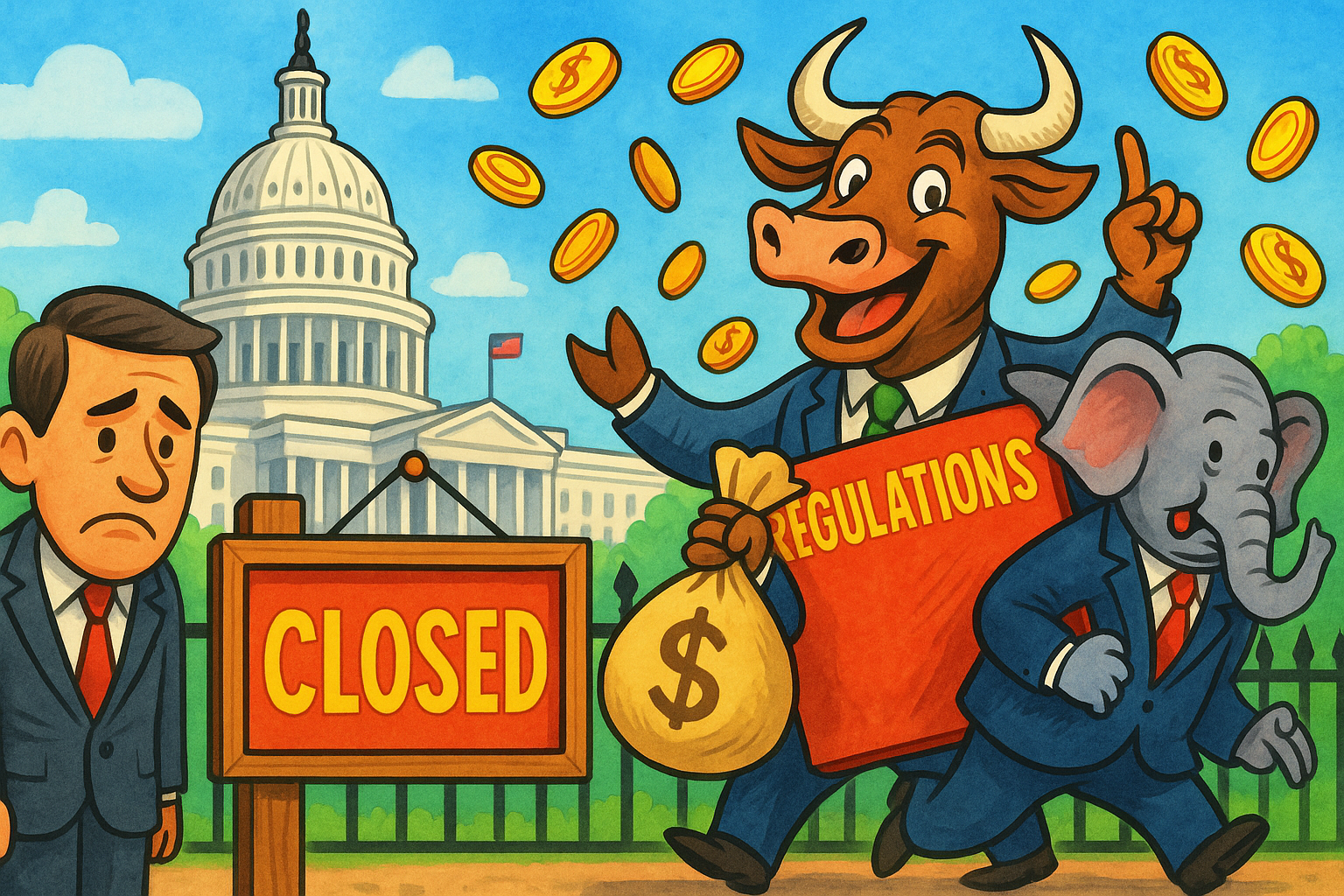
On October 1, 2025, parts of the United States federal government ceased operation following Congress’s failure to approve the 2026 fiscal budget. Without a continuing resolution, numerous agencies lost legal authority to finance non-essential functions. This event marked the third federal shutdown of the 2020s, lasting more than two weeks. Yet, despite the political paralysis in Washington, the United States did not collapse. The military remained active, hospitals continued to function, and air travel proceeded largely uninterrupted. The state, rather than disintegrating, withdrew strategically—its silence becoming an act of governance.
According to the Congressional Budget Office (CBO) (PBS NewsHour, 2025), approximately 750,000 federal employees were furloughed daily, with $400 million in lost wages each day. At the National Nuclear Security Administration (NNSA), 80% of 1,400 staff members were placed on leave (The Guardian, October 17, 2025). Reuters reported that many courts postponed hearings due to a lack of funds. The U.S. Treasury Department estimated weekly losses of $15 billion (The Guardian, October 2, 2025). And yet, markets remained largely unshaken: stock indices held firm, consumption patterns adapted, and private service providers quickly filled administrative gaps.
This apparent contradiction—economic stability amid political dysfunction—reveals a deeper logic of power. The shutdown functions as a demonstration of state restraint as a mode of control. By suspending itself, the government redefines what it means to govern. The paralysis is not accidental; it is a form of discipline, a technique through which the state tests the capacity of society to self-regulate.
In this sense, the 2025 shutdown exposes a key paradox of late-modern governance: the more the state retracts, the more its authority diffuses through the mechanisms it releases. Every furloughed worker, every delayed payment, becomes part of a silent pedagogy of independence. Citizens, companies, and communities learn—almost involuntarily—that survival is possible, even desirable, without the direct intervention of government. In this pedagogical economy of restraint, freedom becomes the new instrument of control.
Such dynamics illuminate the evolution of neoliberal rationality in the American context. Power is no longer exercised primarily through regulation but through the organization of absence. The shutdown creates a temporal field in which the economy becomes self-correcting, individuals become self-responsible, and the market assumes the function of mediator between need and solution. In this configuration, the state’s role shifts from provider to architect—it designs the stage on which others perform autonomy.
As reported by The Washington Post (October 18, 2025), the Trump administration used this moment to review the Department of Education, proposing the dissolution of several directorates in favor of private initiatives. Local institutions and foundations were expected to demonstrate greater “efficiency” and adaptability. Here, the shutdown reveals its political subtext: it is not only a fiscal standoff but also a rehearsal for a smaller, more distributed state—a state that governs by encouraging competition among non-state actors.
At the social level, the U.S. Department of Agriculture (USDA) projected that SNAP benefits—supporting more than 40 million low-income Americans—would run dry by early November (People Magazine, October 17, 2025). Yet, rather than systemic collapse, the gap produced a wave of social improvisation. Churches organized community kitchens, NGOs expanded local partnerships, and major retailers launched corporate assistance programs. The disappearance of public provision thus generated a new form of civic productivity. It showed that when the state withdraws, society’s other organs awaken—not necessarily in rebellion, but in adaptation.
The government’s message was consistent: “the market remains strong.” This statement, ostensibly economic, functions as a declaration of faith in the self-correcting nature of capitalism. It suggests that the system no longer requires continuous state management—it only requires the state’s occasional pause. The shutdown, therefore, becomes both an experiment and a sermon: proof that governance can operate through delay, and that authority can be demonstrated precisely by withholding it.
From a broader perspective, this logic transforms the meaning of sovereignty itself. Power is no longer measured by its capacity to act but by its ability to organize expectation and uncertainty. The state’s silence is not weakness; it is choreography. By stepping back, the government synchronizes public patience, corporate flexibility, and individual self-discipline into a new order of responsiveness. What appears as chaos from the outside is, in fact, a recalibration of control.
This form of governance mirrors the architecture of digital capitalism. Just as platforms manage behavior through invisible algorithms rather than explicit commands, the modern state governs through conditions rather than coercion. It no longer enforces; it curates. The 2025 shutdown thus exemplifies how political power can evolve toward a more aesthetic form—operating through rhythm, timing, and atmosphere rather than direct intervention.
Ultimately, the 2025 shutdown underscores a fundamental transformation in the relationship between the state, the market, and the subject. The state has not disappeared; it has become ambient. It governs through absence, through silence that compels others to act. Each postponed paycheck, each delayed welfare check, becomes an act of instruction: a reminder that freedom is now the language of obedience.
The lesson is subtle but profound. The state remains omnipresent, not through its actions, but through the horizon it sets—the assurance that even in its retreat, life continues according to its rhythm. In this sense, the shutdown is not the breakdown of governance but its perfection: the moment when power governs everything by no longer appearing to govern at all.


