

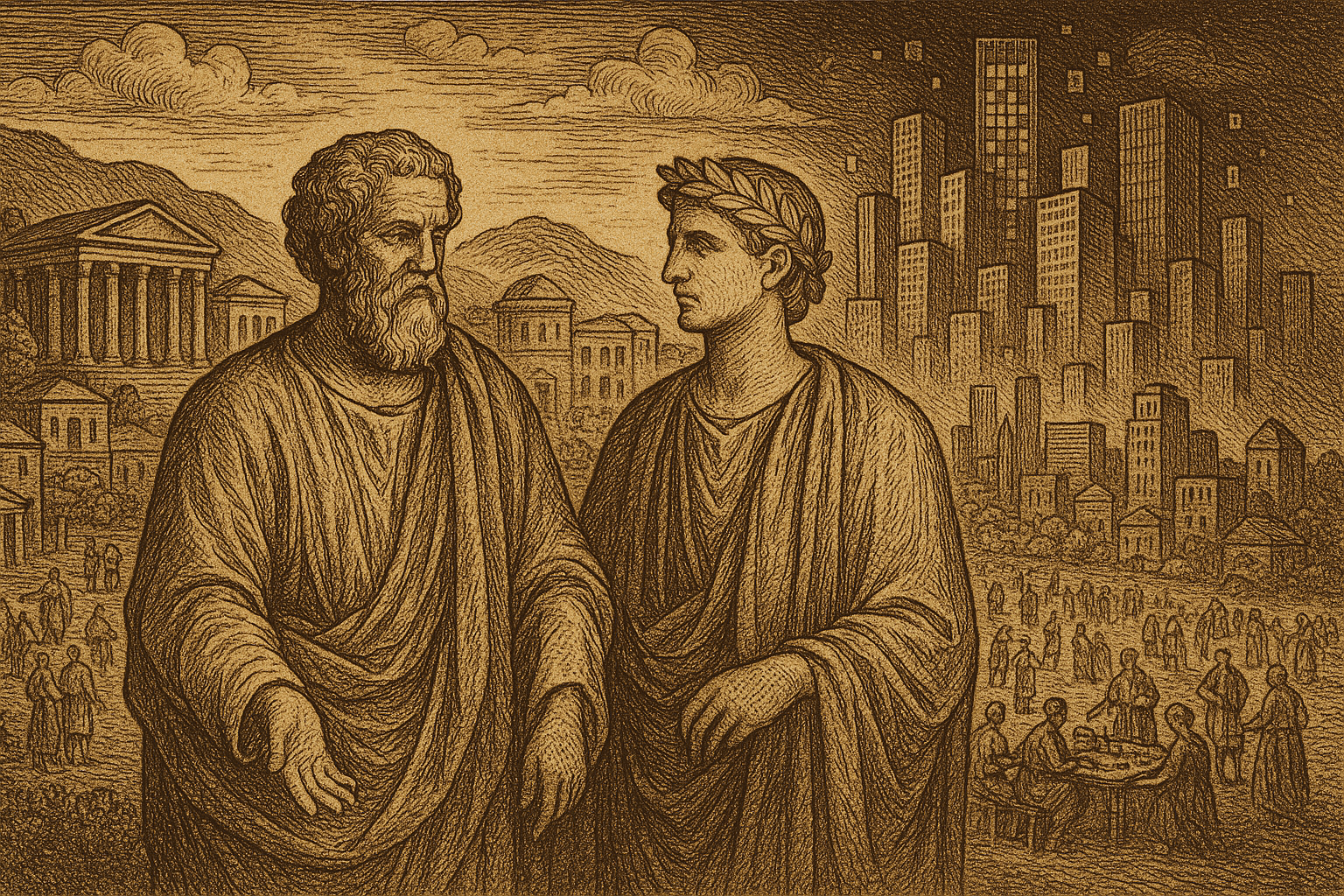
The Origin of Humanity and the Nameless Competition
Before the birth of the gods of ideas, humankind lived under an unwritten law: whoever possesses, rules. The first humans walked upon wild lands, gathering food, fighting, and defending their territory. They did not yet know markets, but they knew exchange; they did not know law, but they understood ownership; they did not know the state, yet they had already formed hierarchies.
In that era, power was not an idea but an instinct. Humans learned that survival meant competition, and that physical strength could be replaced by cunning. From this soil grew the first seed of what would later be called liberal logic: the belief that life is an arena, and man is the actor who shapes his own destiny.
Yet they did not call it “freedom.” Life was merely a continuous struggle, where the strong ruled and the weak adapted. They did not debate morality, for survival itself was considered truth. Here, Liberalis and Mercatus were not yet born—but their spirits already penetrated human life: the instinct to own and the desire to trade.
When humans began to settle and claim land, they learned that power could be inherited without the sword. From ownership was born class; from class, the system. The world did not yet know the idea of liberty, but it already bowed to the law of possession. So when Liberalis and Mercatus were born from the womb of Logos Ekonomikos thousands of years later, they did not create something new—they merely gave a name to what had always been.
The Birth of Classical Liberalism: The Gods Who Shaped the World
It is told that after humanity learned letters and contracts, two spirits descended to earth: Liberalis, the bearer of free will, and Mercatus, the guardian of exchange. They came not into an empty world, but one already ripe with ownership and conflict. Liberalis saw suffering under tyranny and said, “Man must be free from rulers.” Mercatus replied, “And that freedom is possible only if each man owns what is his.”
Thus, they built a new order: Classical Liberalism. This new kingdom stood on three pillars—private property, free competition, and a minimal state. Liberalis taught that every human is rational and capable of self-determination. Mercatus declared that the invisible hand would bring justice if left untouched. The world came alive with a new spirit: merchants became kings, philosophers became advisors, and the state became the market’s gatekeeper. All seemed ideal—freedom became the path to progress, and progress became the proof of freedom.
Yet beneath that promise, new inequality arose. Farmers lost their land to capital owners, laborers sold their living hours, and women were turned into symbols of moral order for a system that no longer knew compassion. Classical liberalism taught that failure was one’s own fault—never the system’s. Thus emerged the first assumption of the new age: the world would be fair if everyone had equal opportunity—without ever asking who wrote the rules of that opportunity.
The Kingdom of Liberalia lasted for centuries, until one day, freedom began to feel like a burden. The people who were said to be free began to feel abandoned. Liberalis looked upon his creation with weary eyes: “Freedom without solidarity becomes a chain.”
Mercatus only smiled: “The chain is of their own choosing.”
The Age of Reform: Freedom That Wanted to Feel
After the golden age of Classical Liberalia, a gentler era arrived—Social Liberalism. Humanity realized that an unrestrained market produced systemic suffering. New rulers with good intentions arose: they did not reject the market but sought to give it a heart. The state returned, not as a tyrant but as a guardian of balance. Hospitals, education, and social welfare emerged to heal the wounds left by the old freedom.
The world shifted from “boundless liberty” to “protected freedom.”
Liberalis looked at this change with mixed relief and anxiety. “Perhaps this is how freedom sustains itself without devouring others,” he said.
Mercatus shook his head: “Every intervention is the seed of slavery.”
For centuries, the two lived in tension. The state began to regulate but dared not challenge the market. Freedom began to be measured by justice, yet justice itself was calculated through efficiency. This reformist age seemed humane, but in truth, it was merely a postponement—for the system still rested on the same logic: humans measured by productivity. Solidarity was a moral ornament for a structure still driven by competition. Liberalis grew old and weary, while Mercatus waited silently to rise again in a new form.
The Fall of Liberalia and the Rise of Neo-Liberalia
When crisis struck, the gentle world crumbled swiftly. The state was blamed for failure, solidarity accused of waste, and efficiency became the new mantra. From the ruins emerged an old spirit with a youthful face: Neo-Mercatus, bearing the banner of “renewed freedom.” He spoke to a tired world: “The state is too fat, morality too slow. Let the market be the healer.”
And mankind believed him. They longed for speed and certainty, not justice. Thus was born Neo-Liberalia—a new version of classical Liberalia, but armed with new weapons: technology, algorithms, and data. Neo-Mercatus no longer spoke of political freedom but of consumer freedom. He no longer preached open competition but unconscious competition—where humans race not by coercion, but by the desire to be recognized. The old Liberalis warned, “You merely repeat the past in a more sophisticated form.”
But Neo-Mercatus replied, “No, I perfect your logic. I make freedom automatic.”
And indeed, the world became efficient. Yet in the silence, humanity lost its depth. Freedom was no longer a conscious choice but a reflex habit. There was no tyranny, no king—only a system that made everything seem natural. Neo-Liberalia was a civilization that loved freedom yet feared stillness. It spun endlessly in circles of productivity, where labor became a new form of worship, and data became its holy scripture.
The Illusion of Freedom and the Mirror of Discourse
Neo-Liberalia is the peak of a civilization that seems free yet hides freedom as a mechanism of control. Humans feel autonomous, yet their lives are curated by the very systems they built. They believe they are choosing—yet what they choose has already been predicted by algorithms that know them better than they know themselves. Neo-Mercatus watches from his data tower. He need not command, for humans now mirror his power. He does not threaten, only seduces—with offers of “opportunity.” He knows that the highest form of power is when humans surveil themselves in pursuit of success that never arrives.
Liberalis returns as a mournful spirit wandering through neon cities. He asks the wind, “Has freedom died?” A voice from the sky answers softly: “No. It has only changed form—into the touchscreen in your hand.”
Freedom now lives in the shadow of consumption, where every decision seems personal but is structurally determined. This is the illusion of freedom: a mirror reflecting a face already designed. And the modern world moves like a drama without a director, where every actor believes himself the author of his own script.
The God Who Sold Souls
Time passed, and Neo-Mercatus no longer spoke the language of economics. He spoke in data, lifestyle, and the fear of missing out.
He became the spirit of speed, offering instant freedom while demanding endless attention.
He sold freedom like a drug—consumed, enjoyed, yet never satisfying.
Humans now work not to live, but to remain relevant. They improve themselves not to be happy, but to avoid being left behind. They built a digital world so fast that there was no time to think. Neo-Mercatus whispered: “True freedom is the ability to adapt.”
And humans believed him.
They adapted until they forgot their own form.
In this perfect system, freedom became the energy that powered the machine.
Man was no longer the subject who chose, but the fuel sustaining the logic he called “progress.”
An Inscription from Our Time
One day in the distant future, amid the ruins of data towers and abandoned cities, a wanderer found an ancient stone engraved with the words:
“When freedom becomes a commodity, slavery becomes voluntary.”
He realized the inscription was not from the distant past but a message from the present refusing to be recognized. Humanity once created gods to liberate itself, but those gods grew into mirrors that devoured their faces. The wanderer carved below:
“Man has never truly been free. He merely moves from visible chains to those he believes are his own will.”
And as the sun set between the ruins of market towers, two voices echoed in the sky—one weeping, one laughing.
Liberalis and Neo-Mercatus—two spirits born from the womb of rationality—were finally reunited, not as opposing ideas, but as a single perfect system: a freedom that governs itself.
Epilogue
Thus ends the tale of a world born from freedom and ending in an order that imitates freedom itself. History turns, but the logic remains: humanity creates systems to choose, and systems create choices so that humanity still believes it is free.
Perhaps in the future, another form will arise—
but it will still call itself freedom.


