

Introduction
Elite forces represent the sharpest manifestation of modern state power. They are not merely instruments of war but also ideological, diplomatic, and moral symbols that reflect how a nation interprets conflict and authority. In contemporary geopolitics, special operations forces serve as instruments of projection—executing covert missions across borders while simultaneously preserving the prestige and legitimacy of their homeland.
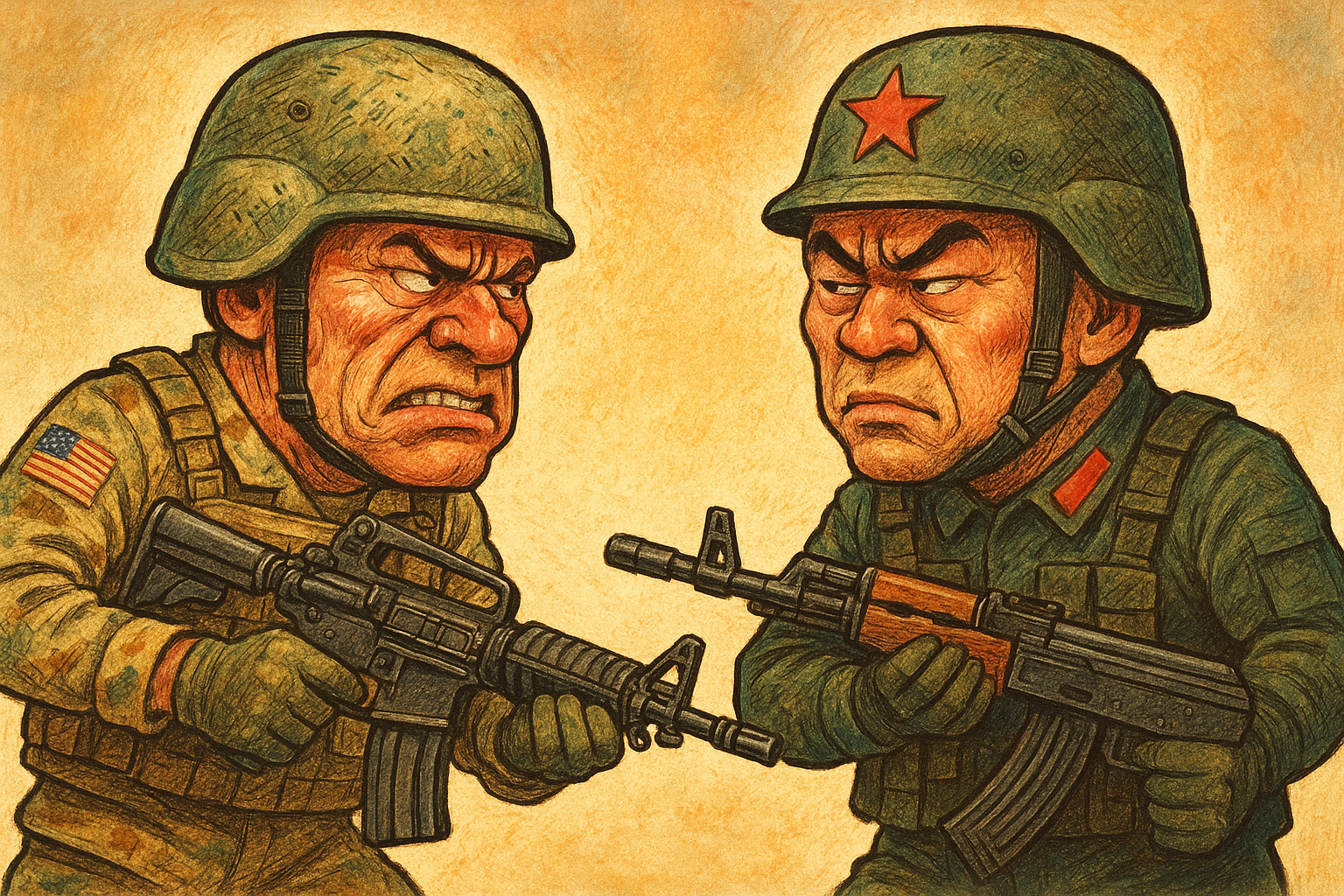
The United States and China embody two fundamentally different military paradigms. The United States conceives its elite units as flexible, independent agents of global power projection, whereas China molds its special forces as the guardians of internal stability, tightly bound to the nation’s political architecture. This essay examines in depth four primary dimensions—structure and operational doctrine, combat experience and professionalism, ideology and military culture, and technology and intelligence—and finally analyzes how each nation might respond to the prospect of a major war in the future, when the world could once again return to an era defined by total confrontation between great powers.
1. Structure and Operational Doctrine
The structure of the United States’ elite forces is marked by decentralization and operational efficiency. Through the Joint Special Operations Command (JSOC), units such as DEVGRU (SEAL Team Six) and Delta Force enjoy a high degree of autonomy, with a direct line of command to the President. This system allows for the rapid execution of global missions with a level of independence rarely granted to other national forces. The Flexible Warfare Doctrine serves as the ideological foundation of this approach, in which success depends on adaptability and the capacity for rapid decision-making under battlefield pressure.
In contrast, the structure of China’s elite forces is rooted in the Active Defense Doctrine, under the authority of the Central Military Commission (CMC), chaired directly by the leadership of the Communist Party. Units such as the Jiaolong Commandos and the Snow Leopard Unit operate with strict adherence to political directives. Their command system is hierarchical, and each mission functions as an integral component of a long-term national defense strategy.
Conceptually, these structural contrasts produce two distinct types of military behavior. The American model emphasizes individual improvisation and tactical flexibility, while the Chinese model prioritizes uniformity of action and collective discipline. The implications for large-scale warfare are clear: the United States dominates in offensive speed and adaptive maneuvers, whereas China excels in coordination, endurance, and systemic consistency.
2. Combat Experience and Professionalism
Combat experience is the most decisive variable in determining the quality of elite troops. Here, the contrast between the United States and China becomes striking.
American special operations forces have been active in nearly every major conflict since the end of the Cold War. They took part in the invasion of Panama (1989), Operation Desert Storm in Iraq (1991), the wars in Afghanistan (2001–2021) and Iraq (2003–2011), and later in counter-ISIS campaigns in Syria and Mosul (2014–2019). Each mission produced new tactical lessons and strengthened joint interoperability across service branches.
During the operation to capture Osama bin Laden, SEAL Team Six operated under extreme pressure—thirty-eight minutes inside the sovereign territory of another nation. The success demonstrated not only tactical precision but also the psychological and moral readiness of American special operators to act decisively under uncertainty. In urban battles such as Fallujah (2004), Delta Force worked alongside regular infantry to control dense city spaces with millimeter-level accuracy, signaling a transition from open warfare to asymmetric engagement.
Each operator within JSOC undergoes multilayered training: survival, digital communication, amphibious infiltration, and subterranean operations. On average, a single member completes over 1,500 training hours per year, with roughly 300 hours devoted to live-combat simulation.
China’s special forces, by contrast, have limited actual combat experience. Since their brief war with Vietnam in 1979, they have not participated in a major armed conflict. Nonetheless, they have maintained a steady presence in strategic non-combat operations such as anti-piracy patrols in the Gulf of Aden (since 2008), the evacuation of Chinese nationals from Yemen (2015), and joint exercises with Russia under the Peace Mission framework.
Although they lack battle exposure, Chinese elite units compensate through a rigorous and centralized training regime. The Jiaolong Commandos, for example, maintain an acceptance rate of barely 10 percent of all recruits, with endurance tests that include ten-kilometer open-sea swims and seventy-two-hour food-deprivation isolation drills.
The sharpest distinction lies in doctrinal orientation. For the United States, combat experience is a foundation for improvisation—they learn through failure and continuously redefine operational standards. For China, discipline and readiness outweigh experimentation; they train not to deviate but to standardize.
Psychologically, American operators possess a mission-oriented mindset—each individual is a problem solver. Chinese operators embody a system-oriented mentality—each is a cog within a greater mechanism. Both are professional, yet their moral bearings differ: the former draws strength from personal initiative, the latter from collective loyalty.
3. Ideology and Military Culture
The military culture of the United States is grounded in constitutional values and liberal ethics. Its elite soldiers are trained to internalize the belief that power is inseparable from moral responsibility. Under the Ethical Warrior Doctrine, the decision to engage or to kill is never purely tactical but must be weighed ethically. For this reason, nearly every operation is accompanied by military legal advisers and intelligence officers tasked with ensuring proportionality of force.
This ethos shapes a rational and reflective military character. Soldiers fight not merely to win battles but to uphold the nation’s moral legitimacy. Even in the most secretive missions—such as the elimination of Abu Bakr al-Baghdadi in Syria (2019)—final authorization passes through layers of legal and ethical review.
China’s military culture, in contrast, is steeped in Marxist-Leninist ideology and the thought of Mao Zedong. The principle that “the Party commands the gun” is not a slogan but a binding moral order. Special operations units are viewed as direct extensions of the Communist Party rather than autonomous professional entities.
In every mission, political loyalty takes precedence over tactical outcome. Ideological education occupies nearly 60 percent of annual training hours, devoted to studying Party doctrine and assessing individual devotion. Success, therefore, is measured as much by ideological conformity as by battlefield efficiency.
These opposing traditions yield two epistemological archetypes of the warrior. The American elite soldier is a critical thinker within an ethical framework; the Chinese elite soldier is a collective actor within an ideological framework. In modern warfare, the former thrives amid uncertainty, while the latter endures within systemic chaos without losing political orientation.
4. Technology and Intelligence Integration
The United States leads the ongoing digital military revolution. The integration of JSOC, the CIA, and the NSA enables near-real-time global coordination. Each elite operation is supported by satellite networks, combat drones such as the MQ-9 Reaper, and secure AI-driven communication systems.
During the bin Laden raid, for instance, operators on the ground received live feeds from forty distinct intelligence sources. Technologies like thermal imaging, biometric identification, and encrypted communication have made American warfare deeply data-dependent.
Over the past two decades, the United States has experienced a dramatic surge in special-operations funding. Since the launch of the Global War on Terror in 2001, the budget for these missions has grown from roughly $2.5 billion to more than $13 billion by 2020. This expansion signals a profound transformation in the paradigm of modern warfare, where victory depends less on troop numbers than on mastery of data, intelligence, and high-tech communication networks. From this evolution emerged a new form of conflict known as data-driven warfare, in which informational dominance sits at the core of strategic success.
China has not stood idle. Following its 2016 defense reforms, Beijing established the Strategic Support Force (SSF) dedicated to electronic, cyber, and space operations. It developed the Beidou satellite-navigation system—now a rival to GPS—and deployed Wing Loong drones operating across the Middle East and Africa.
Yet China’s approach to technology is distinct. Rather than empowering field autonomy, it uses technology to reinforce central control. Information flows upward through political hierarchies rather than outward to commanders in real time. As a result, Chinese elite units excel in information security but respond more slowly to tactical fluidity.
In this contrast, American technology fosters adaptive speed, whereas Chinese technology reinforces systemic stability. The former accelerates human cognition; the latter slows it to preserve coherence and control.
5. Potential and Response to Future Major Wars
Future wars will no longer unfold linearly. They will stretch across multidimensional arenas—cyber, economic, psychological, even biotechnological. In such a context, elite forces cease to be mere strike units; they become strategic architects of victory long before open conflict erupts.
The United States possesses extraordinary doctrinal readiness. Its elite units are designed for global mobility within twenty-four hours. Satellite communication, modular logistics, and integrated multi-command coordination allow simultaneous missions across five continents. In any major conflict, U.S. special operations would form the spearhead of a decapitation strike, targeting enemy command centers before conventional hostilities begin.
Yet this strength doubles as vulnerability. Dependence on digital networks renders operations susceptible to paralysis through cyberattack. Ethical restraints rooted in liberal doctrine can also delay decision-making when confronting adversaries who disregard humanitarian norms. The United States excels at rapid destruction but risks fragility if its technological superiority is neutralized.
China approaches great-power war through an entirely different lens. It views warfare not as an event but as an ongoing political process. Its doctrine favors long-duration conflict, attritional endurance, and information control. In any large-scale confrontation, Chinese special forces would act not spontaneously but as synchronized instruments of political and economic orchestration.
Their advantage lies in strategic coordination and sociopolitical resilience. With a vast population and a highly managed internal system, China can sustain prolonged conflict without social collapse. Its limitation, however, lies in the lack of combat-tested leadership and a command culture that can be slow to adapt.
Analytically, if a major war erupted in the Indo-Pacific, U.S. elite forces would operate as adaptive offensive operators, striking command nodes with precision, whereas Chinese elites would serve as system guardians, preserving logistical, ideological, and political networks under pressure. The United States fights under the principle “winning fast through precision,” while China fights under “winning long through endurance.”
Both represent distinct rationalities of modern power—one built on efficiency and mobility, the other on stability and structure. In their collision, speed would confront endurance; improvisation would clash with uniformity.
Deepened Analysis: Power Simulation and Prospects of Victory
To grasp which side might prevail, one must move beyond technical comparison toward the underlying doctrines of power and moral logic of war.
For the United States, war is an extension of liberal global projection; for China, it is an assertion of internal legitimacy. In a short, fast-paced conflict of up to three months, the United States would dominate. Its technological advantage, combat experience, and network of alliances—NATO, AUKUS, and QUAD—enable the swift dismantling of an opponent’s infrastructure.
However, if war persisted beyond six months, China would begin to balance the scales. With centralized political control, massive industrial capacity, and resilient social cohesion, it could endure pressures that would fracture most democratic systems. As public support waned in the U.S., China’s one-party structure would sustain focus without internal dissent.
Psychologically, American elites fight for professional honor, whereas Chinese elites fight for systemic survival. The United States may win battles, but China could win history. America prevails in spatial dominance; China in temporal endurance. America conquers the day; China prepares for tomorrow.
Thus, a confrontation between the two would not merely be a military clash but a struggle between two global rationalities of power—America’s liberal order rooted in individual freedom and global efficiency versus China’s ideological order grounded in collective discipline and systemic continuity.
Should they ever meet on the battlefield, the world would not witness absolute victory but rather a redefinition of global hegemony—from fast domination to lasting persistence, from individual command to systemic governance.
Conclusion
The comparison between the elite forces of the United States and China reveals two opposing logics of power. The United States elevates individual professionalism and rapid adaptability; China upholds systemic uniformity and collective discipline. The former wins battles through speed and improvisation; the latter endures through order and political continuity.
In any future large-scale war, the United States would hold the advantage in initial strikes and global reach, while China would dominate in structural endurance and ideological resolve. Ultimately, the contest is not about who is stronger, but about how power is managed and sustained.
America teaches the world that power is freedom administered; China demonstrates that power is order preserved.
And between them lies the enduring truth of history: victory does not belong to the one who strikes the fastest, but to the one who endures the longest.


