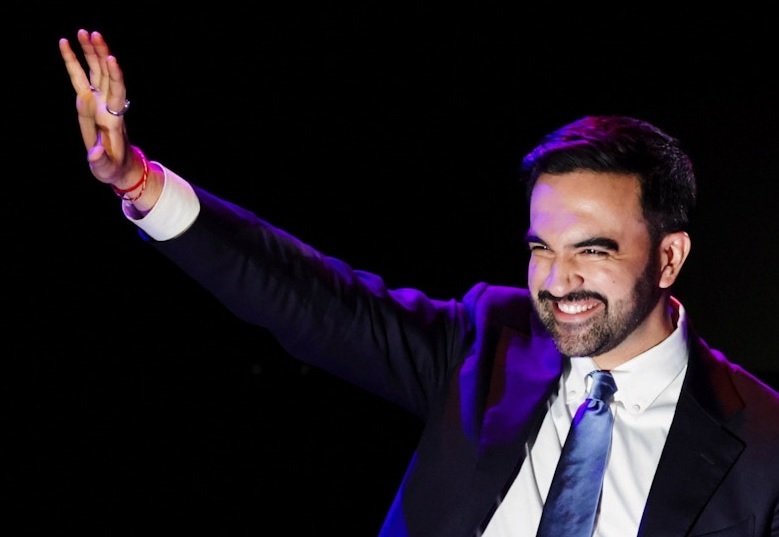
Zohran Kwame Mamdani is not merely the product of a cosmopolitan family—he is the historical articulation of migration, colonialism, metropolitanism, and global urban politics. Born on October 18, 1991, in Kampala, Uganda, to an academic-cinematic family rooted in India and East Africa, Mamdani has lived at the crossroads of history from the very beginning. His father, Mahmood Mamdani, is a postcolonial intellectual renowned for his sharp reading of power politics in Africa; his mother, Mira Nair, is a filmmaker who immortalizes diaspora, identity, and cultural tension in the language of cinema. In that household, migration was not an event but a consciousness; diaspora was not trauma but a space of existential possibility. His middle name, Kwame—referencing Kwame Nkrumah, Ghana’s independence leader—was the initial sign that his political body would always be inscribed in the language of anti-colonialism and liberation.
Zohran’s childhood stretched between Kampala and Cape Town before landing in New York City. In Africa, he absorbed postcolonial memory amid racial, economic, and historical-reconciliation tensions. When he later moved to the United States during his school years, he entered a new social space: a metropolis that claims to be the capital of the world, yet built upon paradoxes—meritocracy resting on privilege, cosmopolitanism born from segregation, and dreams of freedom constrained by the cost of living. His education at the Bronx High School of Science and Africana Studies at Bowdoin College was not simply an academic journey, but an internalization of discursive structures—where race, migration, and power operate as fields of analysis rather than mere identity markers.
As the child of a scholar and an artist, Zohran could have comfortably embodied the global intellectual elite. Yet what stands out is his choice to immerse himself among tenants, city workers, and immigrant communities in Queens. Before entering politics, he worked as a housing counselor—witnessing families of workers, and immigrants from South Asia, Africa, the Arab world, and Latin America navigate landlords, gentrification, and threats of eviction. Here, his ethnographic dimension formed: not observation of marginalized subjects from a distance, but co-existence with them. He did not merely take notes—he queued with them, knocked on doors, filled assistance forms, and listened to stories of rising rents and fear of displacement. This is where his political legitimacy was built—not through myth, but through lived experience.
Culturally, Mamdani carries a complex symbolic capital: a Muslim of Indian-Ugandan descent who can move between diaspora language, Kampala hip-hop rhythms, and New York political dialectics. His music project in Uganda, “Young Cardamom,” was not a nostalgic ethnic gesture, but a performative practice in which diaspora identity returned to an African root rather than being exported to the West. In the frame of political ethnography, this musical project becomes an act of reversing orientalization: a child of the Indian-African diaspora claiming Africa as a space of expression, not merely origin. Mamdani thus emerges not as the “minority included,” but as a “global subject who redefines the center”—from Kampala to Queens, from diaspora margins to the core of American democracy.
Entering formal politics and later elected to the New York State Assembly for the Astoria district, he brought not theoretical doctrine but practiced solidarity: rent freezes, public housing, affordable transit, and universal public services. Here, Mamdani reads the doxa of New York—where speed, productivity, and individualism are treated as morality. Yet he introduces the symptom (in Lacan’s sense): working-class exhaustion, tenant anxiety, economic precarity, and urban alienation. The encounter of the two produces Simtoxa: a political project born from the tension between metropolitan aspiration and the wounds of its social spaces. Rather than rejecting the narrative of “the city that never sleeps,” he rearticulates it—not as the ethos of capital, but of urban solidarity.
From a spatial ethnography perspective, Mamdani’s victory in New York marks a power shift from Manhattan’s elite to the immigrant corridors of Queens and Brooklyn. If Manhattan represents global capital and establishment aesthetics, then Queens is the sacred cartography of the working-class diaspora—where political meaning is not downloaded from institutions, but constructed in community interactions, restaurants, mosques, small churches, bus lots, laundromats, and apartment stoops. Here, Mamdani becomes not merely a “progressive politician,” but a mediator of histories—linking worlds that coexist yet rarely acknowledge one another: global diaspora, city workers, and the aspirations of a young middle class.
Thus, his rise is not just an electoral victory, but a genealogical manifestation: a shift from majority-figure politics to a multi-spatial minority-subject that treats the city as a laboratory of justice. Mamdani did not merely defeat established politicians; he proved that a global city can be led by a child of diaspora carrying memories of three continents and the courage to redefine urban purpose—from capital machine to infrastructure of shared life.
In the United States context, this victory signals a paradigm shift—where the future of politics is no longer defined by white moderate figures forged in elite institutions, but by subjects who bring histories of colonialism, migration, and symbolic resistance into the democratic body. Mamdani stands as proof that in the post-capitalist urban landscape, future leaders are those who not only understand cities, but see them as spaces of wounds, memory, and possibility.
His story reached a historical peak when he won the New York City mayoral election. On June 25, 2025, in the Democratic primary, Mamdani scored a surprise victory against Andrew Cuomo, the former Governor of New York representing the party establishment. The primary used ranked-choice voting (RCV), and through a wave of support from youth, working-class tenants, and immigrant communities across Queens, Brooklyn, and the Bronx, Mamdani secured dominant standing across rounds. His triumph symbolized a shift inside the Democratic Party—from moderate dominance toward a bolder, materially grounded grassroots progressivism.
That momentum continued on November 4, 2025, when Mamdani officially won the general election, defeating Cuomo once again (now running as an independent), as well as Republican Curtis Sliwa. This was not merely an administrative victory; it was the public articulation of New York choosing a progressive urban model prioritizing housing access, tenant justice, affordable transportation, and universal social services. With this win, Mamdani not only became one of the youngest mayors in NYC history, but also the first Muslim of South Asian-African heritage to lead America’s largest city.
His electoral narrative affirms a power structure rooted in community mobilization, grassroots organization, and youth voting strength—a formula now regarded as a blueprint for national progressive strategy. His victory translated diaspora history and ethnographic labor among tenants into concrete electoral support, proving that a global city can be governed not only in celebration of multicultural symbolism, but by those who embody its lived memory.
Mamdani’s rise also marks the emergence of a new left formation in American democracy. He is not simply “progressive” in the electoral sense but represents a left tradition grounded in historical experiences of migration, colonialism, and urban class inequality. Unlike European left populism that often falls into ethno-national identity traps, Mamdani advances a cosmopolitan left—combining metropolitan working-class solidarity with global-diaspora sensitivity. In him, we see a synthesis of urban socialism, anti-colonial politics, and urban ethics of solidarity—not rejecting capital outright, but situating capitalism as a structure to be negotiated, critiqued, and dismantled through democratic institutions and mass movement.
His ideological praxis rests on three layers: urban materialism—justice grounded in concrete access to housing, transport, health, and living space; anti-colonial critique—awareness that power produces identity and language, not just economic inequality; and participatory democracy—mobilizing tenants, informal workers, students, and immigrants as political force. He rejects the romanticism of the “moral left”; instead, he builds an infrastructural left—grounding ideals through public policy.
Mamdani rearticulates socialism not as doctrinal dogma but as a technology of urban life. In his speeches, he rejects the false opposition between modern city efficiency and social justice, showing that a city-state can be a machine for welfare distribution rather than capital accumulation. Free buses are not radical upheaval; they are the reorganization of life value. Rent freezes are not class warfare; they are the restoration of urban dignity. His socialism does not declare utopia—it disciplines reality to serve human life.
Genealogically, Mamdani emerges in the lineage of Third-World left thinkers—Fanon, Nkrumah, Amílcar Cabral, Edward Said, Achille Mbembe—but translates that tradition into 21st-century democratic urbanism. If earlier left generations fought formal colonialism, Mamdani confronts domestic colonization: gentrification as spatial colonialism, city bureaucracy as neoliberal discipline, and cost of living as a mechanism of class domestication. He shifts ideological terrain from “state versus capital” to “city versus market forces that seize living space.” In the era of global metropolises, the most relevant left politics is no longer factory revolution but household, transit, and municipal budget revolution.
In a nation where socialism is painted as foreign threat, Mamdani normalizes left discourse without losing radicality. He does not retreat into revolutionary jargon; instead, he makes daily life the arena of ideology. When he speaks about rent, he interrogates ownership structures; when he defends tenants and marginalized workers, he exposes racial lines of capitalism; and when he demands free buses, he constructs infrastructure for collective freedom. Thus he becomes a new symbol—not a left that announces utopia, but a left that disciplines reality to serve humanity, not the reverse.