

A king is not merely a representation; a king is the power of power itself. For power will perish with the body that bears it, while force never disappears — it only fractures, splits itself, and reproduces new kings throughout history. In every civilization, the king appears not as an exceptional human, but as a form created so that power can be seen, touched, and believed. He is the vessel in which humanity’s fear of chaos is tamed into visible order. When one king dies, power does not die with him; it merely shifts to another body, another symbol, another language. Thus history is not merely a list of rulers, but a series of transformations in the ways power manifests itself.
The Pharaoh in ancient Egypt may be the earliest form of the body of power becoming power itself. His body was law, his face the sun, and every heartbeat was believed to be the rhythm of the cosmos. He did not rule by decree, but by presence. Yet behind the immortality pursued through pyramids and mummification rituals lay a paradox exposing power: the sacralized body reminded all of mortality. The standing pyramids were not symbols of eternity, but acknowledgments of the body’s inability to withstand time. From that fracture, power learned to survive without flesh — by moving into stone, into form, into myth.
The king of Babylon, Hammurabi, continued that lesson. When law was carved into basalt stone, the king’s body was replaced by the body of text. Law became a mirror reflecting power without the king’s presence. This is the first time power understood it could survive without a human body — merely by becoming knowledge repeated. Power found a new mechanism: immortality through writing. Thus emerged the first dispositif: a system of signs replacing flesh, where obedience was produced not by fear, but by clarity etched in stone. The fracture of the biological body birthed the epistemic body.
The Roman Empire later turned the king’s body into an administrative body. In the hands of Augustus, sacredness became logistics. He arranged time, taxes, armies, and laws, not by revelation but by calculation. The king’s body now consisted of networks of archives, coins, statues, and calendars — eyes that watched even in his absence. Thus a new body emerged: one functioning not through blood, but through system. Yet the faceless system summoned back the face. A society governed by rational mechanisms still needed the emperor’s image on city walls, on coins, in narratives of triumph. Power, even when dispersed, still demanded a single point of perspective. Thus monarchy entered its eternal paradox: the more it attempted to free itself from the body, the more intense its desire to find a substitute body.
European feudalism revived that body through ritual. Louis XIV became the most extreme example of power dependent on performance. Versailles was a theater of sovereignty, where the king’s body was the gravitational center for nobles living under his gaze. He ruled through dance, banquets, and choreographed presence. In him, law and aesthetics merged. Yet every performance requires spectators, and every spectator is a potential traitor. Power shown too long before a mirror loses depth: it becomes a shadow of its own gaze. When the king lives only as long as he is seen, power becomes a fragile reflection. That fracture revealed a new face of power — surveillance without violence, where control emerges simply by instilling the awareness of always being watched.
In the East, Emperor Qin Shi Huang and his successors governed with a colder method: bureaucracy. He was not a god but the Son of Heaven, mediator between moral order and cosmos. Yet to maintain that balance, he created thousands of officials, records, and laws forming a vast surveillance network. The king’s body was no longer singular, but distributed. Here, power took the form later called governmentality: managing life through knowledge. The king disappeared as an individual, but arose as a faceless system. He became a moral machine regulating behavior, production, and even dreams.
The Islamic Caliphate introduced another dimension: power rooted in interpreted knowledge. The caliph was not merely a political ruler but guardian of divine truth. Here, the king was replaced by text, but the text lived only through interpretation. Between revelation and interpretation, power found a new arena: not merely regulating behavior, but defining truth itself. Power shifted from body to language, from law to knowledge. It no longer governed; it shaped thinking. The king’s body became an epistemology producing consciousness.
Yet no shift is without residue. When modernity overthrew kings through revolution, only the old form of the king’s body was destroyed, not power itself. The beheading of Louis XVI was not liberation from sovereignty, but redistribution of sovereignty into a new form: the state. The king’s body became the body of law, yet the law soon sought a face. The president emerged not as an antithesis, but a genealogical mutation. He inherited the symbolic function of kingship in secular form. He is not anointed but sworn in; not inherited but elected; yet still the sole voice authorized to speak for all. Thus democracy became a disciplined monarchy, a monarchy hiding its theology behind rationality.
Foucault saw in this transition not separation but hidden continuity. Power never dies, it only changes form: from sacred to administrative, from obedience to surveillance, from body to network. The president, with his media performance, is a king who speaks through data. He governs not by decree but by statistics; persuades not with a crown but with images. Yet within those images, monarchy breathes again. Each time a president appears on screen promising order, he renews the ancient contract between people and symbolic center. The president is a king who refuses the name — a body copying history while pretending to have left it.
But digital technology reveals a new fracture in this genealogy. If kings once commanded the gaze of the people, presidents are now commanded by the people’s gaze. Their bodies fragment into images, clips, memes, and algorithms. They are no longer the center of power but part of its circulation. Yet the genealogical paradox repeats: fragmentation does not abolish monarchy — it renders it eternal. The king’s body now lives in reproducible images. It depends not on blood but on attention. Power has found its digital body — one that does not sleep, does not die, and cannot be beheaded.
Genealogy teaches that every fracture is not destruction, but regeneration. Pharaoh cracks, law emerges; law cracks, system emerges; system cracks, president emerges; president cracks, algorithm takes over. Power never truly changes direction; it merely changes residence. It always seeks a body to remain credible. Thus the real question is not “is the president a king?”, but “why do we still need a king called president?”. What history repeats is not the form of power, but humanity’s need for a face to trust.
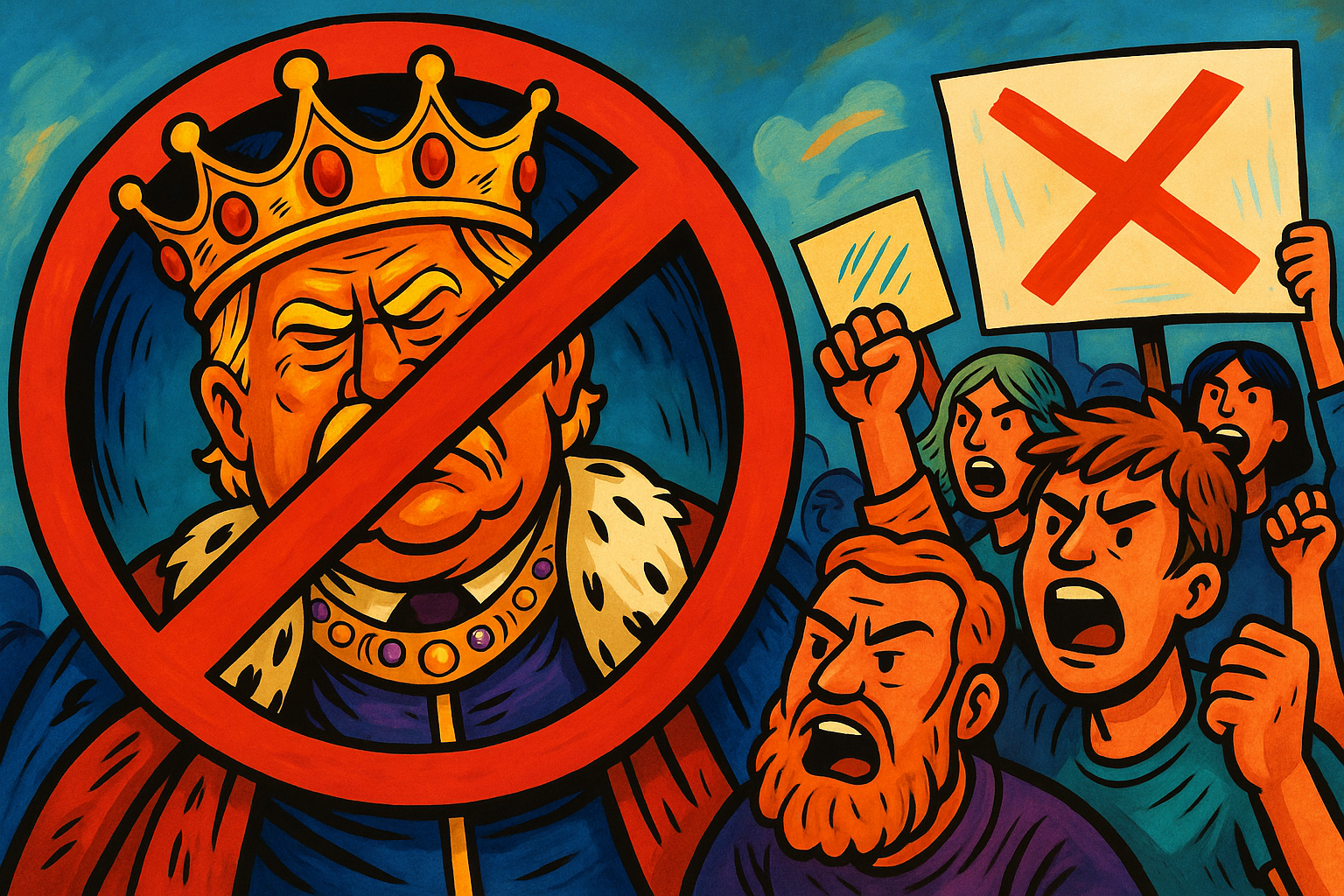
The No Kings movement arises from this genealogical awareness. It understands refusing the king is not rejecting an individual but rejecting the logic of power seeking a central body. It refuses the endless cycle of sovereign reproduction making citizens perpetual spectators of another body. It is the moment society, perhaps for the first time, reads history not as bloodline but as desire-line. In the cry “No Kings”, lies an attempt to sever the tie between power and body; to let power exist without a face.
A king is power, thus he will always crack. Yet power, lacking form, will always find a new king — in law, in system, in media, even in presidents. Genealogy does not seek who rules, but how we create those who seem worthy to rule. And as long as humans need a face to trust order, the age of kings will never end. But amid that spiral, No Kings becomes a rare event: the moment humans attempt life without a center, allowing power to remain while refusing the body embodying it. A small step in a long history teaching power, perhaps for the first time, to live without a king.
Yet No Kings is not merely a moral scream or anti-authoritarian sentiment. It is a recognition of power structures operating deeper than leader turnover. Behind posters and chants lies a quiet awareness that modern democracy faces the same question once haunting ancient palaces: can society function without a central figure? And if the absence of kings is the goal — who will regulate social order once the figure is removed?
In No Kings actions, crowds no longer fix their gaze on one stage but on themselves. Every body present affirms itself as part of a power network refusing subordination to a single symbolic center. Posters of crossed-out crowns or leaders parodied without reverence are not mere satire, but epistemic declarations: truth must not take a single form. The paradigm of representation collapses, replaced by horizontal, fluid, leaderless communal presence — a choreography of resistance shifting power’s locus from figure to relation.
If classical monarchy was theater placing one body on stage, No Kings is anti-theater: the stage dissolves, spectators become collective actors. Thus arises a key genealogical implication — rejecting kings does not mean rejecting governance, but rejecting the metaphysics of unity that undergirds Western politics for millennia. By refusing the king, they refuse the myth of “one truth”, “one voice”, “one center of legitimacy.” This is not the destruction of order but creation of the possibility that order emerges from many voices bound without subordination.
In the cry “No Kings”, lies critique of democracy that never fully abandoned monarchical logic. It challenges the promise that the people are the source of power, yet still require a face to believe. It exposes the paradox of republics becoming periodic monarchies — kingdoms elected on schedule. No Kings does not reject a figure; it dismantles the cultural-psychological structure making that figure possible.
Undeniably, the movement’s energy comes from a specific historical experience: the rise of a leader fusing populism, media persona, and national personification — a figure seen by some as salvation, by others as threat to the republic. Yet genealogically, the issue exceeds any name. What is at stake is the future of how society understands power itself. If a president can again become a king — albeit without a crown — democracy becomes merely a cosmetic monarchy. No Kings rejects that aestheticization. It rejects surrendering freedom to a reassuring figure.
Thus No Kings is not an end but a beginning of new political consciousness: a stage where citizens realize power may require no body but collective willingness to sustain fracture itself. That absence of center is opportunity, not danger — a test of whether society can live without mythologizing figures. History waits for the moment humans no longer seek faces to believe — and perhaps, in this still-failing yet determined attempt, No Kings is the most radical experiment pushing the world toward that possibility. A world where power no longer needs a king to be real.
Yet there is irony etched within every No Kings cry: this movement rejects not only kings literally, but the monarchical psychology hidden beneath democracy. From its founding, the United States was built with a phobia of kings — not merely politically, but as trauma from absolute power. The Founding Fathers did not just write a constitution; they built a mental structure separating power from singular body. Yet since George Washington, the public has yearned for a figure to trust. Washington himself feared this: he refused to be a monarch, yet people longed for a face they could believe.
American political history is a tension between fear of kings and longing for them. Every strong president is praised like a grand ruler; every weak president condemned as a betrayer of destiny. From Lincoln as savior of the nation, Roosevelt as savior from the Great Depression, to Kennedy as mythic figure — all show power needs symbolic bodies to remember, mourn, adore. Thus No Kings confronts America’s psycho-political memory of leader-glory.
In the digital era, that memory is harder to dismantle. Social media turns leaders’ bodies into endlessly replicable visual commodities: clips, expressions, gestures, tweets, emotional moments. The leader does not appear; he haunts. He appears on walls, phones, memes, short videos engineered for instant emotional attachment. The president is not merely a ruler; he is an avatar of national unity, a symbolic code binding collective imagination. Modern mediascape reinforces monarchical residue: loyalty tied to image and algorithm, not crown.
The No Kings movement responds to this visual logic. It redirects the gaze: from one face to many, one voice to many voices, one narrative to polyphony. Through chants and marches, it urges society not to anchor stability in a figure. It attempts to break consciousness that subconsciously grants legitimacy to persona, not democratic practice. In essence, No Kings shifts legitimacy from charisma to collectivity, from symbol to structure, from presence to process.
Yet the movement faces an existential challenge: humans are symbolic beings. We need not only law but faces; not only systems but figures embodying hope. This makes No Kings radical — it challenges human anthropology, how we understand ourselves and the world. It forces democracy toward maturity: a stage where the public relies not on figures but shared consciousness and persistent participation independent of personal magnetism.
If classical monarchy operated by theology of power, media democracy operates by aesthetics of presence. No Kings seeks to destroy both. It aims to prove social order can be upheld by a network of subjects mutually watching each other, not one figure watching all. That the state can function not because of a leader on a podium, but because of institutions, participation, shared awareness. This is not only a political demand; it is epistemic — a demand to transform knowing, believing, and recognizing authority.
If the movement succeeds, it becomes the greatest epistemological revolution in modern politics: a shift from symbolic body to distributed consciousness. If it fails, it proves a frightening truth: that humanity, despite millennia of civilization, cannot sever dependence on figures. And if so, the king is not dead — he merely awaits his next body.


