

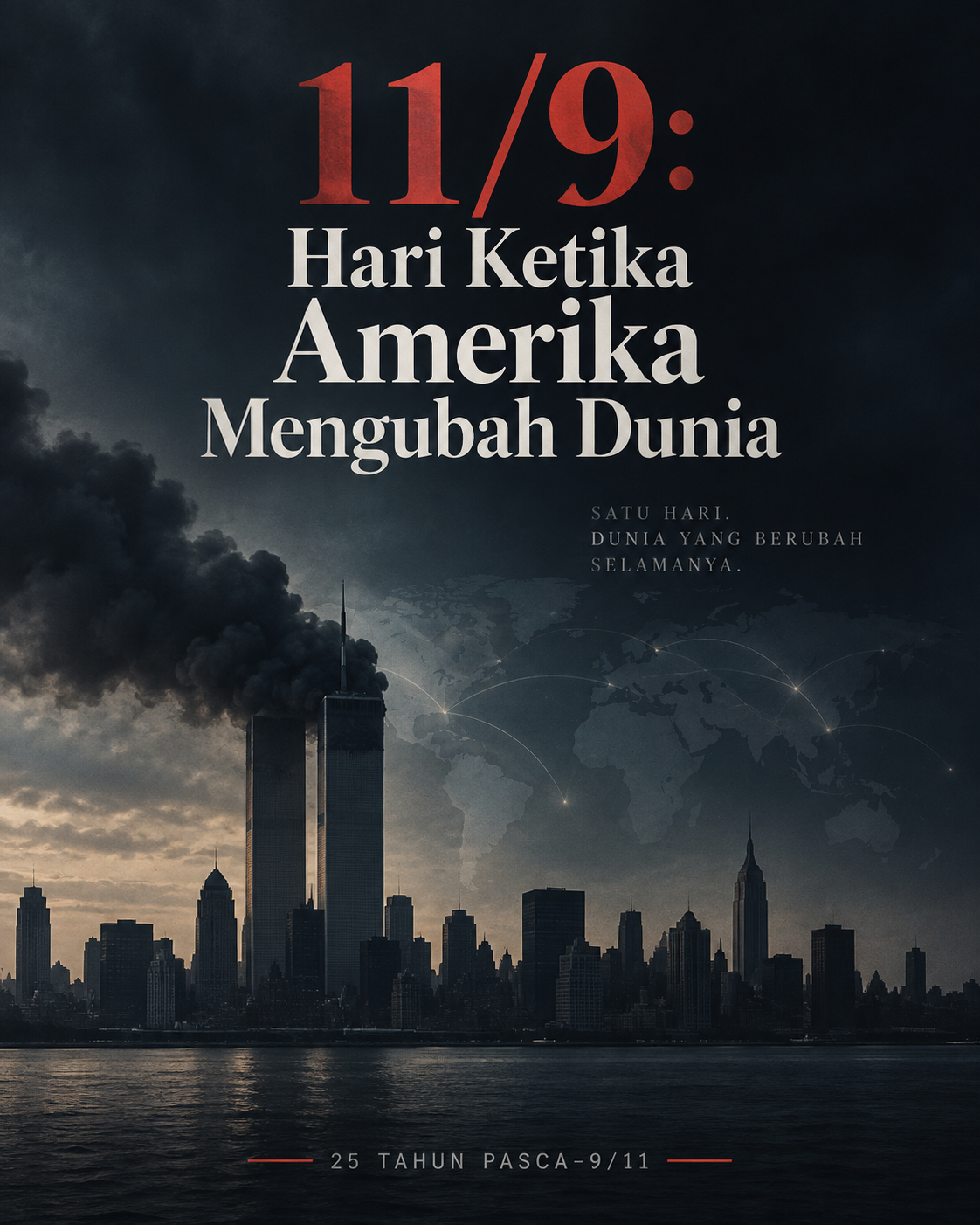

Power is paradoxical. September 11, 2001 exposed this paradox in its most explicit form. The attacks on the World Trade Center and the Pentagon revealed the vulnerability of the center of global power, yet simultaneously generated an unprecedented expansion of the United States’ capacity to define threats, designate enemies, and determine the legitimate boundaries of the use of force. 9/11 did not immediately diminish America’s position in global politics. Rather, it created the historical conditions through which American superiority was transformed into a security rationality operating beyond national territory. From that moment onward, threats to the United States were no longer treated merely as domestic security concerns, but increasingly projected as threats to the global order.
Realist interpretations tend to conceptualize 9/11 as an asymmetric attack against a unipolar power, as though the principal question concerned how a hegemonic state could restore deterrence and preserve the distribution of power established after the end of the Cold War. Such a reading is too narrow because it reduces power primarily to the possession of capabilities. 9/11 demonstrated that global power operates at a deeper level through the capacity to define the meaning of threat and institutionalize that meaning as political truth. The United States did not merely respond to an attack. It transformed its particular experience of insecurity into a universal category of international security. Terrorism consequently ceased to appear simply as one form of political violence among many global threats and became an organizing principle for war, alliances, borders, intelligence, human mobility, and the legitimacy of intervention. The central question, therefore, is not whether 9/11 ended American unipolarity, but how the vulnerability of the hegemon enabled the United States to expand its authority to determine what the world should fear.
From this emerges what may be called hegemonic vulnerability, a condition in which the vulnerability of the hegemon does not produce a contraction of power, but instead becomes a condition for its reproduction and expansion. The United States transformed 9/11 through a process of universalization of threat, whereby a threat directed specifically against America was translated into a threat to international security. This process simultaneously produced security translation, understood as the hegemon’s capacity to transform a particular experience into a language of security that is subsequently accepted, reproduced, and institutionalized by other actors. At the same time, sovereignty entered a logic of exception. It remained formally preserved as a foundational principle of international order, yet could be constrained whenever a state, territory, network, or individual was defined as part of the field of threat. In this sense, 9/11 generated global insecurity, a condition in which American insecurity ceased to remain a national experience and became a principle through which global security itself was organized.
The War on Terror consequently became more than a foreign policy doctrine. It developed into a security regime that reconfigured the relationship between threat, sovereignty, and the legitimacy of violence in international politics. The United States no longer merely defended itself against attack, but constructed a new order of threat through the categorization of failed states, transnational networks, non-state actors, and spaces considered beyond effective control. This produced an expansion of the security field, in which the geographical boundaries of war became increasingly indeterminate and threats could be located wherever they could be connected to a possible attack on American interests. War itself became deterritorialized. It was no longer entirely tied to identifiable fronts, formal declarations of war, or clearly defined state adversaries, but increasingly operated through intelligence operations, precision strikes, extraterritorial detention, financial surveillance, and mobility control. 9/11 therefore did not merely produce new wars. It transformed the conditions under which war could begin, the actors against whom violence could be directed, and the grounds upon which such violence could acquire international legitimacy.
This transformation first occurred through the universalization of the American threat. One day after 9/11, NATO invoked Article 5 for the first time in its history, transforming an attack against the United States into an attack against the alliance as a whole. Six days later, the Authorization for Use of Military Force was enacted on September 18, 2001, granting the President of the United States authority to use force against states, organizations, or individuals deemed to have planned, assisted, or harbored those responsible for the attacks. The formulation was significant because the object of war was no longer confined to states, while the geographical boundaries of war remained unspecified (U.S. Congress 2001). The process rapidly acquired a global dimension. By June 2002, the U.S. government recorded that 69 countries were supporting what it termed the global war on terrorism, while 20 countries had deployed more than 16,000 personnel to the operational area of U.S. Central Command (U.S. Department of State 2002). A threat against one state was thus transformed into a transnational security coalition. What became globalized was not merely the response to terrorism, but the American definition of who should be regarded as a threat.
The next expansion occurred through the deterritorialization of war. In 2004, the U.S. Department of State stated that more than 3,400 individuals associated with al-Qaeda had been detained in more than 100 countries, with capture operations extending from Pakistan and Southeast Asia to Europe and the United States (U.S. Department of State 2004). The battlefield could therefore no longer be identified solely with territories in which war had been formally declared. A similar logic was embodied in Guantánamo Bay. Since the detention facility opened in 2002, nearly 780 individuals have been held there, creating an extraterritorial space that politically demonstrated how the War on Terror extended security practices beyond the conventional distinction between domestic jurisdiction and the battlefield (U.S. Department of Defense 2020). 9/11 thus did more than expand the use of American force. It transformed the geography of power by allowing individuals to be constructed as part of the battlefield without physically occupying a conventional war front.
This deterritorialization subsequently moved from bodies and territories to data, transactions, and mobility. Following 9/11, the U.S. Department of the Treasury established the Terrorist Finance Tracking Program to obtain and analyze transaction information through the SWIFT network. The program generated hundreds of thousands of intelligence leads for the United States and other governments, while the relocation of part of SWIFT’s data storage to Europe eventually produced a formal U.S.-European Union agreement that entered into force on August 1, 2010 (U.S. Department of the Treasury n.d.). At the same time, human mobility was increasingly incorporated into a security data regime. The Department of Homeland Security required international airlines to provide Advance Passenger Information and Passenger Name Record data, including identity, nationality, passport number, itinerary, address, and reservation information. By 2010, Secure Flight was conducting government watchlist screening for all passengers travelling on U.S. airlines and covered more than 90 percent of travel to, from, and within the United States (U.S. Department of Homeland Security 2010). Post-9/11 power therefore no longer operated only when military forces entered a territory. It operated when transactions could be read, journeys traced, identities screened, and potential threats identified before an act occurred. This marked the transition from security as response to security as anticipation.
Post-9/11 security thus shifted from response to anticipation. The 2002 National Security Strategy asserted the right of the United States to act pre-emptively even when the time and location of an enemy attack remained uncertain, allowing a potential threat to acquire political legitimacy before becoming an empirical reality (The White House 2002). Iraq in 2003 demonstrated this logic when allegations concerning weapons of mass destruction and future threats became grounds for the use of force. Security consequently ceased to operate solely by responding to danger. It increasingly sought to govern the future by acting upon possibility.
After 9/11, the world entered a phase in which American security became one of the principal organizing logics of global politics. Afghanistan became a space of punishment, Iraq a space of anticipation, while alliances, intelligence networks, borders, financial systems, surveillance technologies, and human mobility were increasingly organized through a logic of threat produced from Washington. War no longer possessed a clearly bounded front, enemies were no longer necessarily states, and threats no longer had to become actual before producing political consequences. From the Middle East to Asia, from military bases to passenger data, the legacy of 9/11 demonstrates that the United States did not merely exercise power within the international order. It participated in determining how that order understood danger, legitimacy, and security. In this sense, the twenty-five years after 9/11 can be read as twenty-five years of an American world.
Twenty-five years later, the paradox continues to operate. The United States no longer monopolizes the distribution of power, yet it continues to exert considerable influence over the distribution of threat. China has altered the material balance of power, Iran challenges American power projection in the Middle East, and emerging powers have narrowed the space once occupied by unipolarity. Yet these transformations continue to be interpreted through questions concerning the position of the United States. The world may be becoming increasingly multipolar in the distribution of power, but it is not yet fully multipolar in the production of threat. This is where 9/11 remains politically present: America may lose part of its dominance, but it has not yet lost its capacity to make the world react to what it defines as dangerous.
Power in international politics can never be understood entirely through victory, defeat, or the distribution of material capabilities. It also persists through the capacity to shape knowledge, determine threats, and establish the boundaries of legitimate action. Twenty-five years after 9/11, the mystery of American power lies precisely there. China rises, Russia challenges, Iran resists, and numerous states seek greater strategic autonomy, yet the world continues to debate these transformations through America’s position and response. The paradox of 9/11 therefore remains unresolved: an attack that once exposed American vulnerability ultimately left behind a security architecture within which the world continues to move through the consequences of American fears, decisions, and definitions of threat.
