

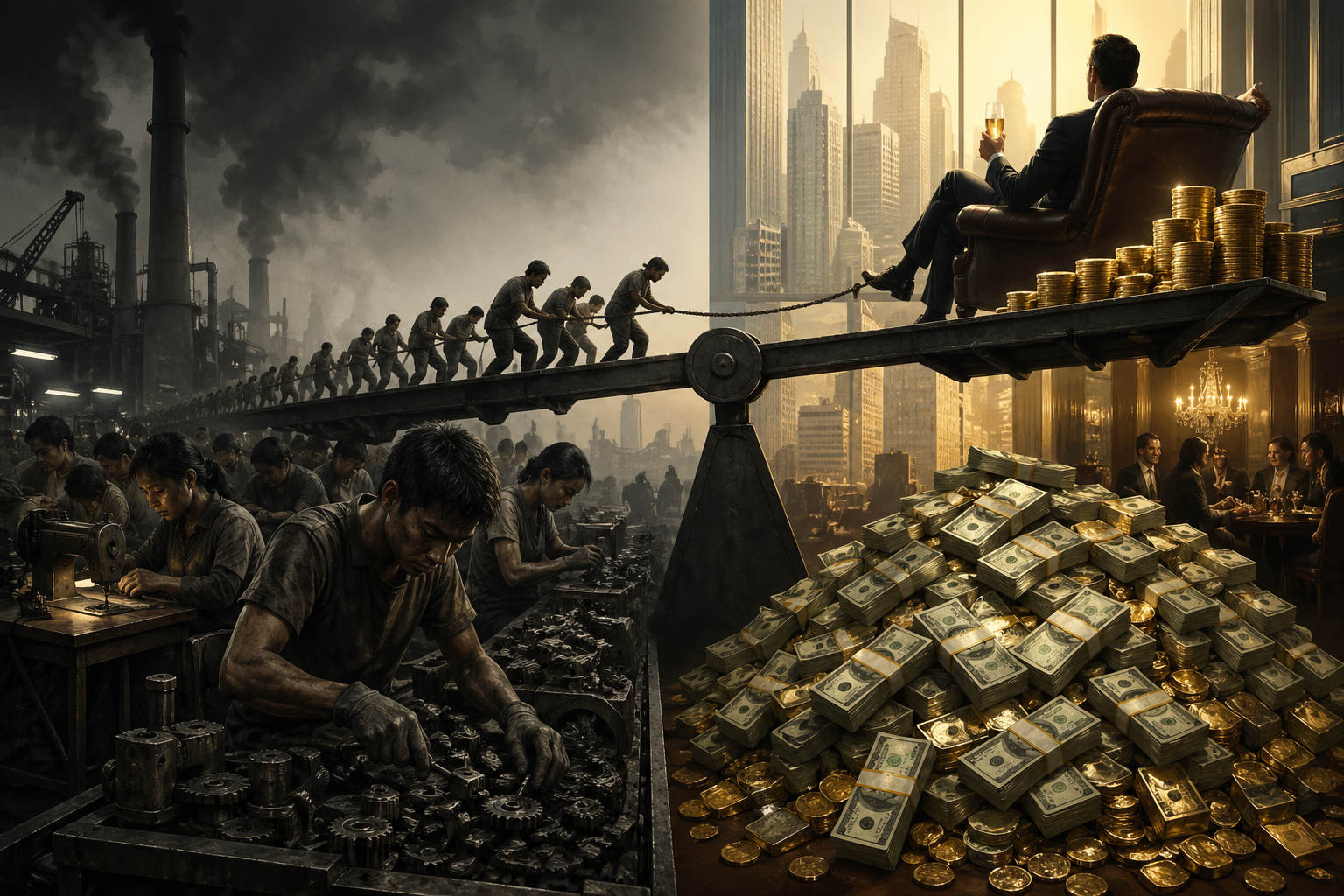
Labour appears as the origin of wealth; yet within it lies a mechanism that is not immediately visible, namely how labour becomes a source of accumulation for those who do not work. In this sense, labour cannot be understood as a quality inherent in individual activity, but rather as a function of the relations of production that condition it. It is labour power alone that constitutes the source of capital accumulation, not because labour is intrinsically rich, but because it is commodified and inserted into the structure of capital. Labour power, as a specific commodity, possesses the capacity to generate value that exceeds its own exchange value; and it is from this differential that capital accumulation becomes possible. Consequently, the more extensively capital appropriates labour power, or the more workers are purchased, the greater the volume of labour that can be mobilized, and with it the greater the accumulation of value produced for the owners of capital. However, this accumulation does not return to the workers as its source, but is instead concentrated in the capital that controls it. In this formulation, the circulation of M–C–M’ affirms that labour power as a commodity constitutes the condition of possibility for the expansion of value; thus, without workers there is no labour, and without labour there is no wealth. Accordingly, the history of the working population cannot be separated from the history of capital accumulation itself: a process in which human labour continuously produces wealth that accumulates not in itself, but in the hands of those who control the relation.
Labour is never fully remunerated. Within every process of production, there exists a differential of value that does not return to the worker, but is appropriated as the basis of accumulation. Labour power is purchased not merely for its value, but for its capacity to produce value in excess of that value. Wages are not intended to represent the entirety of labour performed, but only to reproduce labour power so that it remains available within the production process. Thus, labour is always divided between paid labour and unpaid labour, and it is precisely within the latter that accumulation takes place. The more labour power is organized, the greater the differential of value produced, and with it the greater the wealth concentrated in the hands of capital. In this sense, labour not only produces commodities, but continuously reproduces the separation between value created and value received. At this point, labour can no longer be understood as a path to wealth for workers, but rather as a mechanism that systematically generates wealth outside of itself.
Labour does not merely produce value; it simultaneously reproduces the conditions that make such production possible. In each cycle of production, labour power is not only utilized, but also restored so that it can be utilized again. The necessity of life compels workers to continuously sell their labour power, and through this, the same relation is perpetually reproduced. Labour therefore does not end with the production of commodities, but also produces the continuity of the structure that binds workers to the process. This relation does not rely on direct coercion, as it operates through unavoidable material necessity. The more labour is repeated, the more entrenched the structure that governs it becomes, such that workers are not only involved in production, but also in the reproduction of the conditions that sustain their position as labour power. At this point, labour is no longer merely an economic activity, but a mechanism that secures the reproduction of the system itself.
Labour not only reproduces its material conditions, but also shapes the way it is understood and accepted. Through continuous repetition, labour appears as something natural, as though the relations that govern it have no alternative. The necessity to live, the obligation to work, and the expectation of welfare form a consciousness that no longer questions the structure within which it is embedded. In this sense, labour does not operate merely as an economic activity, but as a form of internalization of the relations that sustain it without the need for overt coercion. Workers do not simply sell their labour power; they also accept this condition as an inseparable part of life. What is reproduced, therefore, is not only labour power, but also the consciousness that sustains the system. The more labour is enacted as routine, the more it loses its character as a relation that can be questioned, and the more it appears as an immutable reality.
Labour, in the totality of its relations, can no longer be understood as a neutral activity that produces wealth, but as a mechanism that determines how wealth is distributed. Within it lies a relation that separates those who produce value from those who accumulate it. The problem of labour, therefore, does not lie in how hard or how much labour is performed, but in who controls labour as a source of value. This structure explains why an increase in labour does not automatically lead to an increase in workers’ welfare, as its results are from the outset directed toward accumulation beyond itself. Labour, in this sense, not only produces commodities, not only reproduces itself, and not only forms consciousness, but also establishes the limits of the possible distribution of wealth. To understand labour, then, is to understand the relation that determines who becomes wealthy and who remains working in order to survive.
Throughout the history of production, labour has consistently appeared as both the source of wealth and the basis of recurring exploitation. The Industrial Revolution in England in the late eighteenth century recorded working hours ranging from twelve to sixteen hours per day, with a predominance of women and child labour, while the value produced was accumulated by factory owners (Thompson 1967). In the twentieth century, global industrial expansion extended this pattern across regions, from textile factories in Asia to manufacturing sectors in the United States and Europe (Hobsbawm 1999). Entering the twenty-first century, approximately 3.3 billion people constitute the global labour force, the majority of whom remain in conditions that do not fully secure their welfare (International Labour Organization 2023). These data indicate a consistent continuity: labour always produces wealth on a massive scale, yet its distribution remains concentrated. Thus, the history of labour not only records the development of production, but also reveals how exploitation persists as a pattern reproduced across different forms and periods.
Capital accumulation at the global level assumes the form of a dependency structure that divides the world into layered configurations: central countries, central of the periphery, periphery of the center, and periphery of the periphery. This division is not merely geographical, but reflects differentiated positions within the international division of labour, in which the center concentrates high-value functions, while the periphery supplies labour power and raw materials in subordinate positions. From this perspective, class distinction does not operate solely within nation-states, but extends to the global level as a relation between regions that accumulate and those that sustain that accumulation. Within the global capitalist system, this structure produces patterns of underdevelopment that are not internal failures, but consequences of unequal integration. Capital accumulation, therefore, is no longer confined to relations between capitalists and workers within a single space, but operates as a global network that organizes labour, distributes value, and systematically reproduces inequality across nations.
Labour at the global level is organized through the operations of multinational corporations that structure labour across borders within integrated value chains. These corporations connect centers of consumption with low-cost production sites through networks of retail, production, subsidiaries, and acquisitions. In the retail sector, companies such as Walmart reported revenues of approximately USD 611 billion in 2023, while Amazon exceeded USD 574 billion in the same year, demonstrating the scale of global distribution dependent on logistics and platform labour (Walmart 2023; Amazon 2023). On the production side, Apple Inc. recorded revenues of approximately USD 383 billion in 2023, with supply chains concentrated in Asia, particularly through suppliers such as Foxconn, which employs millions of workers (Apple 2023). Through subsidiary networks, energy corporations such as ExxonMobil reported net profits of approximately USD 36 billion in 2023 from global operations (ExxonMobil 2023). Meanwhile, acquisition strategies continue to expand capital concentration, as seen in Microsoft’s acquisition of Activision Blizzard for nearly USD 69 billion in 2023 (Microsoft 2023). These data illustrate that global capital accumulation is inseparable from the organization of labour across nations, whereby the value produced by the global working class is accumulated by the corporations that control these networks.
On the other side of this accumulation, the material conditions of the working class reveal an opposing pattern. Global wages do not increase in proportion to productivity, and in many cases remain at levels sufficient only for the reproduction of labour power. Reports by the International Labour Organization indicate that real wage growth contracted in 2022 due to inflation, with millions of workers experiencing declining purchasing power (ILO 2023). Working hours also remain high; in many developing countries, workers in manufacturing and informal sectors work more than 48 hours per week, often exceeding these limits without adequate compensation (ILO 2022). Joint studies by the World Health Organization and the ILO show that working more than 55 hours per week is directly correlated with severe health risks, including premature death (WHO & ILO 2021). In the global garment sector, for instance in Bangladesh and Vietnam, minimum wages often fall below living wage standards despite generating billions of dollars for global corporations (Clean Clothes Campaign 2020). These data reveal a structural consistency: intensification of labour and extended working hours do not result in wealth distribution to workers, but rather expand accumulation for capital owners. Exploitation, therefore, is manifested not only in the differential of value, but also in the concrete living conditions of workers who remain within minimal thresholds, while the wealth they produce continues to accumulate outside of them.
Ultimately, the entire sequence reaffirms a fundamental logic that remains unchanged: wealth does not originate from labour as an activity, but from labour that is purchased and mobilized within the circulation of capital. What appears as the production of goods and economic growth is, at its core, a recurring movement of value, in which money enters the sphere of commodities to appropriate labour power, and from there returns as expanded value. In this sense, labour never stands as an end, but as a medium through which the expansion of value proceeds indefinitely. As long as labour power remains a commodity, accumulation will continue to operate in the same pattern, producing wealth on one side and limitation on the other. Thus, the formula M-C-M’ is not merely a theoretical abstraction, but an operational principle that explains how capital develops: money becomes capital only insofar as it can purchase labour, and from labour it returns as expanded wealth.


