

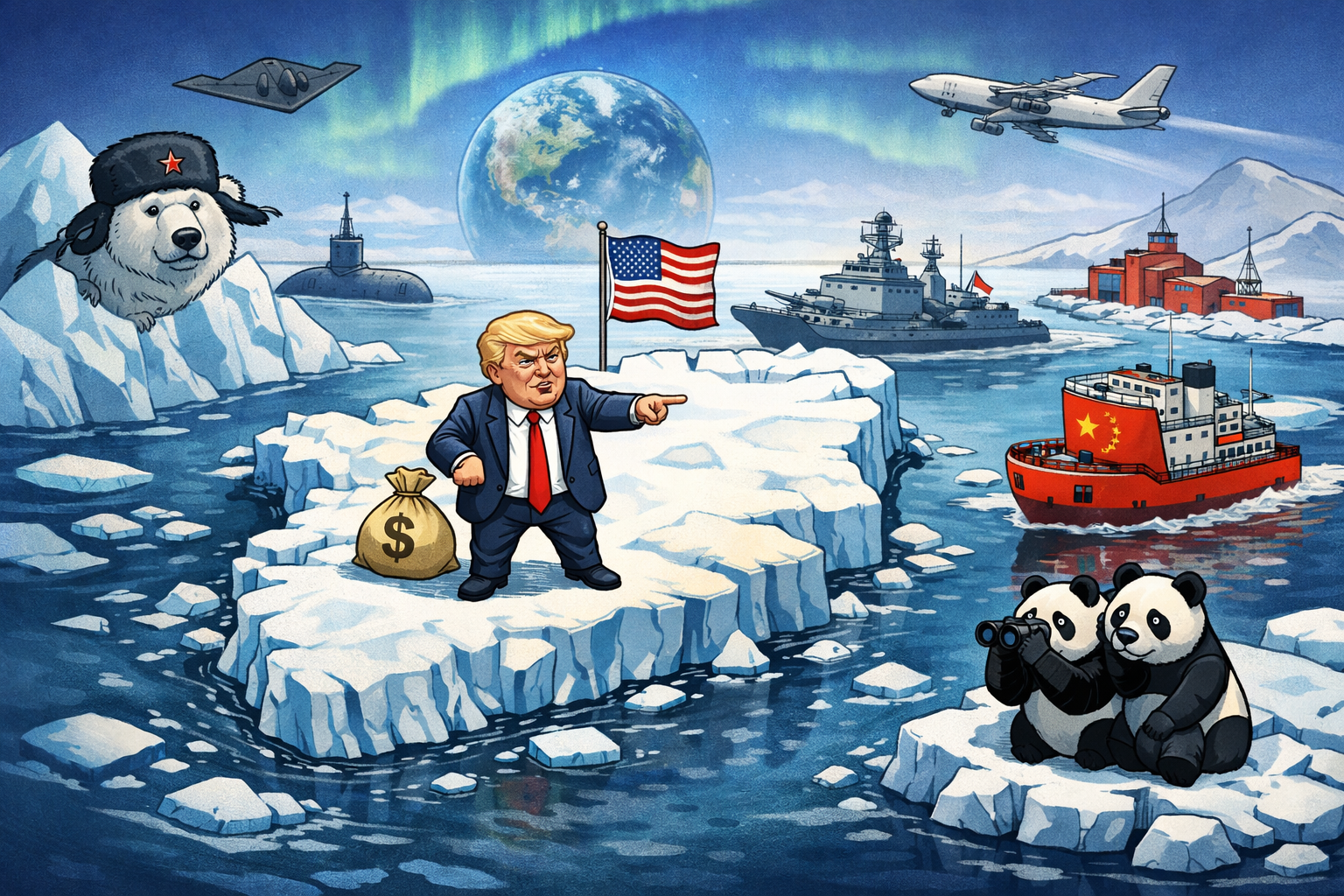
President Donald Trump’s push for the United States to “take over” Greenland on security grounds has once again placed China in a position it did not politically choose but that has been discursively imposed upon it. In several public statements in early January 2026, Trump linked U.S. interests in Greenland to the need to prevent Russia and China from expanding their influence in the Arctic. Chinese state media noted that within this rhetoric, China was not presented as a concrete actor with specific actions, but rather as an abstract threat figure invoked to legitimize the strategic agenda of the United States (Xinhua 2026a).
Beijing’s response was swift yet measured. At a press conference of the Ministry of Foreign Affairs of the People’s Republic of China on 5 January 2026, spokesperson Lin Jian firmly rejected what he described as the use of a “so-called China threat” as a pretext for pursuing unilateral interests. Lin emphasized that the Greenland issue should not be framed through fabricated threat narratives and warned that such practices risk undermining Arctic stability and the international rule-based order (FMPRC 2026). This statement is significant because China did not engage in technical debates over vessels or specific activities, but instead rejected the narrative framework employed by the United States from the outset.
This position was not ad hoc. It is rooted in China’s official Arctic policy, formalized with the publication of the state document China’s Arctic Policy by the State Council in January 2018. In that document, China explicitly stated that it has no territorial sovereignty claims in the Arctic, including Greenland, and affirmed that its involvement is constrained by international law, particularly the United Nations Convention on the Law of the Sea. At the same time, China asserted its legitimate interests in navigation, scientific research, the peaceful use of resources, and participation in Arctic multilateral governance, on the grounds that climate change and the development of Arctic shipping routes have global implications (State Council Information Office PRC 2018).
Within this framework, Beijing interprets U.S. pressure over Greenland not as a bilateral issue between Washington and Copenhagen, but as a potentially dangerous precedent. Xinhua highlighted that Greenland occupies a strategic position within the North Atlantic security architecture, lies along the GIUK gap, and simultaneously holds potential mineral resources such as rare earths, graphite, nickel, and copper. Data cited by Xinhua indicate that although Greenland’s ice-free territory has expanded due to climate change, by the early 2020s only two mining projects were actively operating, suggesting that Greenland’s strategic value remains more prospective than actual (Xinhua 2026b). This fact reinforces China’s argument that threat narratives function more as political instruments than as responses to factual conditions on the ground.
China’s strategy on this issue can be read through three interrelated layers. The first layer is narrative delegitimation. By directly rejecting the concept of a “China threat,” Beijing seeks to sever the chain of legitimacy required by the United States to justify pressure-driven changes to territorial status. Rather than rebutting accusations point by point, China rejects the basic premise of the debate and shifts attention from external threats to the internal political motives of the United States (FMPRC 2026).
The second layer is the locking of the issue into law and multilateralism. The 2018 Arctic Policy document consistently positions China as a rule-bound participant rather than a challenger to the existing order. In the Greenland context, this approach grants China a relatively secure moral position from which to criticize unilateral pressure without explicitly siding with any regional actor. China does not need to express direct political support for Denmark or Greenland; it suffices to affirm that altering territorial status through coercion violates the foundational principles of international governance (State Council Information Office PRC 2018).
The third layer is long-term investment in science and the economy as forms of non-military strategic presence. Chinese media repeatedly emphasize that China’s Arctic interests relate to access to shipping routes, climate research, and supply-chain stability, not territorial control. By maintaining the Arctic as a space of scientific and economic cooperation, China preserves access while avoiding the political resistance that typically accompanies military presence (Xinhua 2026b).
Several Chinese analysts reinforce this reading. Lü Xiang, a researcher at the Chinese Academy of Social Sciences, argues that linking Greenland to a “China threat” reflects a longstanding pattern in U.S. hegemonic policy that requires external enemies to justify influence expansion. According to Lü, the issue reflects Washington’s need to maintain narrative dominance rather than a response to actual Chinese activities in the Arctic region (Global Times 2026).
From this position, several relatively concrete predictions can be drawn. First, China is likely to maintain a consistent public communication line that rejects threat narratives and emphasizes international law and multilateralism, without engaging in rhetorical or military escalation. Second, Beijing will strengthen Arctic knowledge politics through scientific research, institutional cooperation, and normative diplomacy, as this pathway aligns most closely with its official policy and is the most difficult to disrupt without damaging the legitimacy of other actors. Third, should U.S. pressure intensify, China is likely to exploit the legitimacy costs faced by the United States on the global stage, portraying Washington as an actor that undermines stability and pressures even its own allies, rather than as a guardian of a rules-based order (Xinhua 2026a; FMPRC 2026).
Thus, China’s position in the U.S.–Greenland issue is not a covert attempt to seize territory, but a deliberate strategy to refuse being used as a pretext while ensuring that the Arctic remains embedded in legal and governance frameworks that allow China long-term participation. Within this logic, victory is not measured by territorial possession, but by the ability to determine which language is legitimate for altering the global political map.
Selective Sovereignty as the Foundation of China’s Foreign Policy
To fully understand China’s position in the U.S.–Greenland tensions, it must be situated within the broader architecture of Chinese foreign policy—namely, the principle of selective sovereignty. This principle affirms that every political entity has the right to determine its historical trajectory, institutional form, and development path without external pressure. Unlike normative sovereignty approaches that demand systemic and value uniformity, China has developed a practice of sovereignty grounded in plural political pathways and the rejection of externally imposed will.
Within this framework, selective sovereignty functions as both a protective device and a tool of normative projection. On one hand, it shields China from the legitimization of intervention in its own domestic affairs. On the other, the same principle enables Beijing to challenge unilateral pressure by major powers on other territories or entities without direct involvement. When China refuses to be used as a pretext in the Greenland issue, that refusal does not rest on political alignment with any party, but on doctrinal consistency: the future of a territory must be determined by its own political subjects, not by the security calculations of external actors.
This principle also explains why China deliberately avoids positioning itself as an alternative protector or patron for Greenland. Offering protection or alliance would undermine the credibility of the very notion of selective sovereignty China seeks to uphold. Rather than replacing one form of domination with another, China chooses to position itself as an actor interested in keeping decision-making space open and free from coercion. In Chinese foreign policy thinking, international stability emerges not from the expansion of jurisdiction, but from recognition of the diversity of sovereign and developmental paths.
This approach grants China discursive advantage when the United States confronts even its own allies. In the Greenland case, U.S. pressure on an autonomous territory opens a narrative gap that China can exploit without any operational involvement. By insisting that political choices must originate from the political subject concerned, China implicitly positions the coercive actor as a source of instability. This strategy allows Beijing to expand its normative influence simultaneously across regions, as the message conveyed is universal rather than narrowly tied to Chinese interests.
Against this background, China’s position in the U.S.–Greenland tensions appears not as a short-term maneuver, but as a consistent expression of a foreign policy architecture developed incrementally over time. Selective sovereignty serves as the bridge between China’s national interests and the global governance order it seeks to promote. Within this framework, refusing to be used as a pretext carries the same strategic weight as keeping the Arctic within a legal and cooperative space—one in which China can be present, participate, and derive structural advantage without incurring the political and military costs of overt expansion.


