

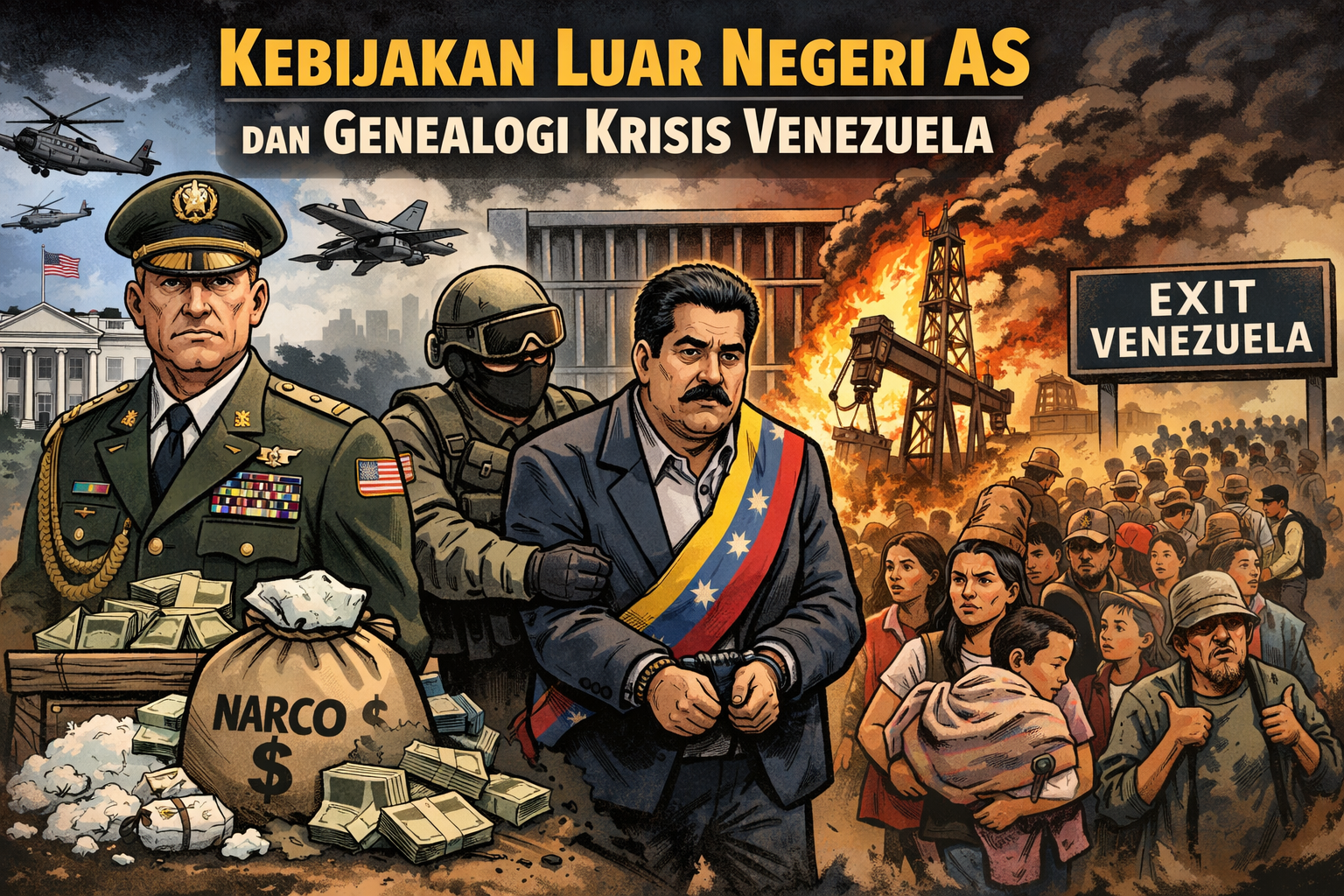
The relationship between the United States and Venezuela is the product of a long history of managing Latin America as a strategic space of the Western Hemisphere. Since the early twentieth century, the United States has constructed the region as an area of vital interest—not merely because of geographic proximity, but due to its role in energy security, political stability, and the prevention of external power penetration. Venezuela began to acquire a distinct strategic position following the discovery of large oil reserves in the 1910s and 1920s, which turned it into one of the principal energy suppliers for U.S. industry during World War II and the early Cold War (Tugwell 2018).
During this period, U.S.–Venezuela relations were built through a pattern of authoritarian symbiosis. Washington supported the regime of Juan Vicente Gómez and his successors so long as oil stability was maintained and economic nationalism did not threaten the interests of American corporations. The Venezuelan state was accepted as a partner insofar as it remained predictable and controllable. This pattern reflects a longstanding logic of U.S. foreign policy in Latin America, in which national sovereignty is formally respected but substantively constrained (Grandin 2006).
A major transformation occurred at the end of the twentieth century with the rise of Hugo Chávez to power in 1999. Chávez was not merely a new president, but a figure who symbolically ruptured this historical continuity. The nationalization of the oil industry, the restructuring of PDVSA, and the use of oil revenues for social programs and regional diplomacy challenged the established center–periphery architecture (Ellner 2011). In Washington’s reading, Venezuela shifted from a problematic partner to a dangerous precedent, particularly as Chávez sought to build alternative regional blocs through ALBA and to deepen relations with Russia, China, and Iran.
The attempted coup against Chávez in 2002—later revealed to have involved actors sympathetic to the opposition and to have received an ambiguous response from the United States—marked an escalation into open conflict (Golinger 2006). From that moment, U.S. policy toward Venezuela moved into a pattern of gradual delegitimation. Support for political opposition forces, the use of international human rights mechanisms, and diplomatic pressure became primary instruments, while the military option remained in the background as a latent threat.
Chávez’s death in 2013 opened a new phase in the genealogy of the Venezuelan crisis. Nicolás Maduro inherited a state heavily dependent on oil, but without the symbolic capacity and charisma of his predecessor. The collapse of global oil prices in 2014 accelerated economic breakdown, while mismanaged monetary policy exacerbated inflation, pushing it into hyperinflation within the following years (Hausmann and Muci 2019). The United States interpreted this phase as a qualitative shift: from an ideologically defiant regime to a state failing to perform basic functions.
From 2017 onward, U.S. sanctions against Venezuela intensified systematically. Restrictions on access to international financial markets, oil embargoes, and the freezing of state assets were no longer aimed merely at behavioral change, but at the paralysis of the regime’s fiscal capacity (Weisbrot and Sachs 2019). In official U.S. discourse, Venezuela began to be classified alongside states perceived as sources of transnational instability, aligned with narratives of failed states and criminal states.
The 2020 narcoterrorism charges against Nicolás Maduro and the inner circle of the state elite constituted a critical moment in the genealogy of U.S. foreign policy. For the first time, a sitting head of a sovereign state was explicitly positioned as a transnational criminal actor rather than as a legitimate political subject (U.S. Department of Justice 2020). This move blurred the boundary between foreign policy and law enforcement, allowing intervention to be presented as a juridical action rather than as geopolitical aggression.
The leadership of Donald Trump accelerated this logic. Trump was not interested in long-term global order engineering, but in demonstrations of power that were rapid, communicable to domestic audiences, and low in internal political cost. In multiple statements, Trump consistently linked Venezuela to narcotics and migration crises burdening U.S. cities, framing intervention as a direct form of protection for American society (CBS News 2026). Foreign policy was thus directly fused with domestic political logic.
The U.S. attack and the arrest of Venezuela’s president constituted the culmination of this long process. The operation was not designed to occupy territory or construct a new government, but to sever the symbolic center of state power. The United States had learned from Iraq and Afghanistan that occupation produces counter-delegitimation and long-term costs. In Venezuela’s case, the chosen strategy was the hollowing out of sovereignty without reconstruction.
Global responses to the attack confirmed the normalization of selective intervention within the contemporary international order. Russia and China issued diplomatic condemnations but did not escalate with strategically risky actions (Reuters 2026). Latin American states were divided between principles of non-intervention and pragmatic concerns related to Venezuelan migration flows that had burdened their social infrastructures for years (UNHCR 2024). The European Union expressed normative concern while once again acknowledging the limits of its capacity to act independently of the United States (Politico 2026).
Another crucial layer in the genealogy of the Maduro regime’s collapse of legitimacy is mass migration that has been prolonged, cross-class, and transnational. Since Nicolás Maduro assumed power in 2013, Venezuela has experienced one of the largest population exoduses in modern Latin American history. United Nations data indicate that the number of Venezuelans migrating abroad increased from approximately 700,000 in 2015 to more than 5 million by 2018, continuing to rise beyond 7.7 million by the end of 2024 (UNHCR 2024; IOM 2024). This figure represents more than one quarter of Venezuela’s total population, a proportion rarely observed in the migration history of non–armed-conflict states.
The geographic distribution of this migration reveals a highly regionalized pattern. Colombia hosts approximately 2.9 million Venezuelans, Peru around 1.5 million, Chile about 530,000, Ecuador approximately 475,000, and Brazil around 430,000. Outside the region, the United States hosts more than 770,000 Venezuelans, while Spain has become the primary European destination with more than 500,000 Venezuelan migrants (R4V Platform 2024; UNHCR 2024).
The largest migration surge occurred between 2016 and 2019, coinciding with extreme hyperinflation, shortages of food and medicine, and the collapse of basic public services. The World Bank recorded that real household income in Venezuela fell by more than 75 percent, while poverty levels surged to over 90 percent of the population (World Bank 2022). Under such conditions, migration shifted from an economic choice to a survival strategy.
Beyond economic factors, political dynamics played a significant role. Reports by human rights organizations documented increased arbitrary detention, restrictions on freedom of expression, and the criminalization of political opposition during Maduro’s rule. For many citizens, migration became an escape from a state no longer perceived as a protector, but as a source of fear and uncertainty (Human Rights Watch 2023).
The composition of this migration further reinforces the argument of delegitimation. Early waves were dominated by educated middle classes and state professionals, followed by working-class and impoverished groups undertaking dangerous overland routes to neighboring countries. Regional surveys indicate that the majority of Venezuelan migrants do not plan to return in the near term, even if economic conditions improve, due to a loss of trust in the political and institutional stability of the country of origin (IOM 2022).
In this context, mass migration is not merely a consequence of failed policy, but a genealogical indicator of the collapse of the relationship between the state and its subjects. The state lost its most fundamental function: guaranteeing the survival and future of its citizens.
It is at this final point that the response of the Venezuelan people acquires its historical weight. International media reported significant celebrations among Venezuelan diaspora communities in the United States, Latin America, and Europe following the arrest of their own president (AP 2026; Reuters 2026). This phenomenon does not function as moral legitimation for the United States, but as confirmation that the symbolic relationship between the regime and its people had long been severed. In many historical cases, foreign intervention produces national consolidation. The absence of such a reflex on a broad scale in Venezuela indicates that the state had lost its representational function long before the attack occurred.
Genealogically, U.S. foreign policy in the Venezuelan case did not create destruction from nothing. It operated upon layers of historical crisis that had accumulated over time. The attack was not the beginning of Venezuela’s collapse, but the moment when a state that had lost internal legitimacy was no longer able to sustain its claim to external sovereignty.
Within this logic, U.S. foreign policy no longer operates as an inter-state relationship, but as a mechanism of classification: determining who can still be treated as a political subject and who is reduced to an object of enforcement.
Venezuela does not demonstrate that sovereignty can be destroyed by external power, but that sovereignty becomes fragile when it is no longer sustained by its own citizens. Under such conditions, intervention does not arrive as a violation, but as a consequence of a long history that has already hollowed the state of its own representational meaning.


