

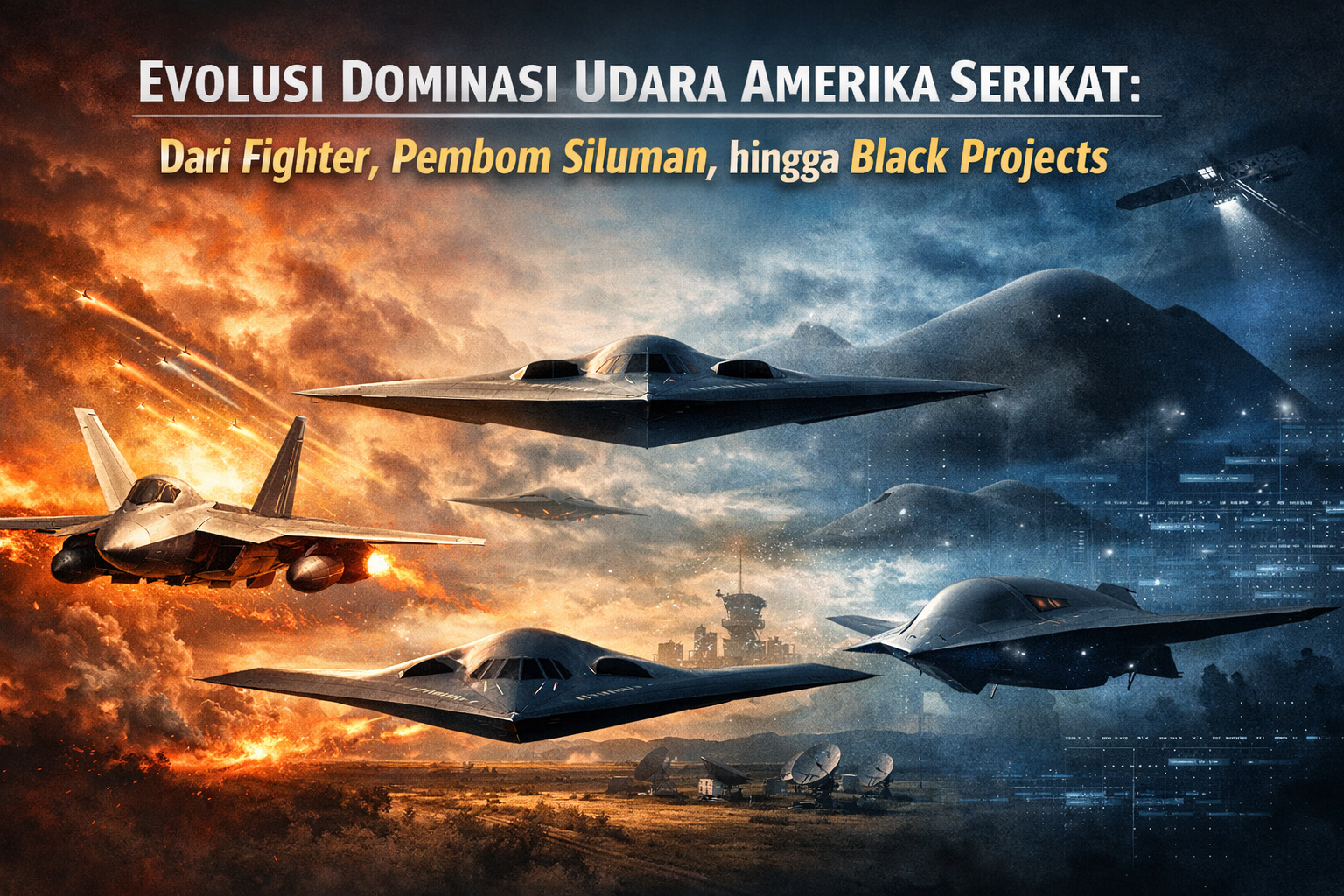
The development of United States fighter aircraft began with the first generation, a period in which jet technology had only just replaced propellers and aerial warfare was still understood as a direct extension of World War II–era dogfighting. Aircraft such as the F-86 Sabre, F-80 Shooting Star, and F-84 Thunderjet defined this phase, characterized by subsonic or transonic performance, cannon-based armament, and the absence of mature combat radar. Air combat remained dependent on close-range engagements, pilot reflexes, and visual formations.
The second generation emerged as the Cold War created an urgent need for rapid interception of strategic bombers. Fighters were designed to fly at supersonic speeds and equipped with early radar and air-to-air missiles, though both remained limited in capability. Aircraft such as the F-100 Super Sabre, F-101 Voodoo, and F-104 Starfighter reflected the era’s belief that speed alone was the key to victory. Subsequent combat experience, however, revealed that this doctrine oversimplified the realities of aerial warfare.
Awareness of this complexity gave rise to the third generation, in which radar became more reliable, missiles more precise, and multirole capability began to take shape. Aircraft such as the F-4 Phantom II and F-111 Aardvark were widely employed during the Vietnam War and throughout the Cold War. Although designed primarily for long-range, radar-based engagements, this generation once again demonstrated the importance of flexibility, maneuverability, and pilot skill under real combat conditions.
The fourth generation marked a major leap in the balance between technology and human control. Fighters became more agile and aerodynamically refined, equipped with mature avionics without sacrificing dogfighting capability. The F-15 Eagle, F-16 Fighting Falcon, and F/A-18 Hornet formed the backbone of American air dominance for decades. At this stage, air superiority was no longer defined solely by technological advantage, but by the integration of systems, training, and doctrine.
From this foundation emerged the so-called fourth-and-a-half generation, a transitional phase that introduced AESA radar, advanced electronic warfare, and network integration without full stealth characteristics. Aircraft such as the F-15EX Eagle II, F-16V Viper, and F/A-18E/F Super Hornet demonstrated that non-stealth platforms remained relevant when paired with modern sensors and weapons. This generation functions as a force multiplier and complement to more advanced platforms.
The current peak of fighter evolution lies in the fifth generation, where aerial warfare shifts from physical engagement to information dominance. The F-22 Raptor and F-35 Lightning II are built around comprehensive stealth, sensor fusion, and networked combat capability. Fighters in this generation no longer operate as independent platforms, but as nodes within a broader system of air power.
Beyond this, the United States is moving toward a sixth generation through the NGAD program, which is no longer conceived as a single aircraft but as an integrated combat ecosystem. This system incorporates artificial intelligence, loyal wingman drones, and total dominance of the information domain. The evolution confirms that fighter aircraft have moved beyond their role as machines and become strategic instruments within the architecture of global power.
As fighter evolution reaches its apex with the fifth generation and transitions toward the sixth, the logic of American air power shifts from tactical dominance to strategic decision-making. At this point, stealth bombers assume roles that no fighter can fulfill. The B-2 Spirit was never designed as an air superiority platform, but as an instrument for penetrating sovereignty. Conceived at the end of the Cold War, the B-2 shattered the assumption that layered air defenses could guarantee national security. With its flying-wing design, minimal radar signature, and intercontinental range, the B-2 enabled the United States to strike the most sensitive targets without warning, using either conventional or nuclear weapons. If fifth-generation fighters dominate the battlefield, the B-2 effectively erases the battlefield by introducing an existential threat that cannot be reliably prevented.
Yet the B-2 does not represent the end of this trajectory. As modern air defense systems evolved into multisensor networks combining radar, infrared detection, and electronic warfare, the United States developed a more radical successor in the B-21 Raider. The B-21 is not merely an update in form or materials, but a paradigmatic shift. It is built as a digital platform from the outset, featuring an open architecture that allows software upgrades, system integration, and continuous adaptation to future threats. If the B-2 symbolizes the success of stealth as a physical technology, the B-21 embodies stealth as a living system capable of constant evolution. The line of development thus becomes clear. Fighters reach their peak as tools of tactical dominance, while next-generation stealth bombers emerge as the pinnacle of absolute sophistication, where technology, politics, and power converge in a single strategic platform.
Beyond the B-21 Raider, the narrative of sophistication can no longer be written as a catalog of aircraft that can be photographed or displayed. At this stage, American air power enters a domain that is deliberately unpublished, not because it does not exist, but because its strategic value lies precisely in uncertainty. In American military tradition, this realm is known as black projects, a space in which platforms, functions, and even physical forms are never disclosed, and whose existence is inferred only through budgetary traces, ambiguous documents, and doctrinal shifts.
At this level, “something more advanced” does not necessarily mean a fighter or bomber in the classical sense. It may take the form of intercontinental unmanned stealth systems, hypersonic maneuverable platforms beyond detection, or integrated strike architectures that combine satellites, drones, artificial intelligence, and precision weapons into a single automated decision chain. If the B-21 can still be understood as an aircraft, the subsequent phase marks the removal of the aircraft itself as the central element, replaced by systems that require no pilot, no fixed bases, and no formal declaration of war.
This domain does not exist outside institutional structures; on the contrary, it is deeply rooted in American defense research organizations such as DARPA, which has long functioned as an incubation space for technologies that may only become visible decades later, if at all. Many technologies now considered standard on platforms like the F-35 or B-21 spent years as classified projects before entering the public domain. The most rational assumption, therefore, is not to ask whether something more advanced than the B-21 exists, but how long the gap is between its existence and its acknowledgment.
In terms of power, this stage represents the most radical shift of all. If fifth-generation fighters dominate the air, and stealth bombers dominate strategic decision-making, then undisclosed systems dominate the imagination of adversaries. They operate not only through the capacity to strike, but through the production of permanent uncertainty. Opponents do not know what form they take, where they originate, or when they might be deployed. At this point, the highest form of sophistication is no longer measured by technical specifications, but by the ability to remain unproven. It is here that American air power fully exits the realm of open technology and enters the realm of pure power.


