

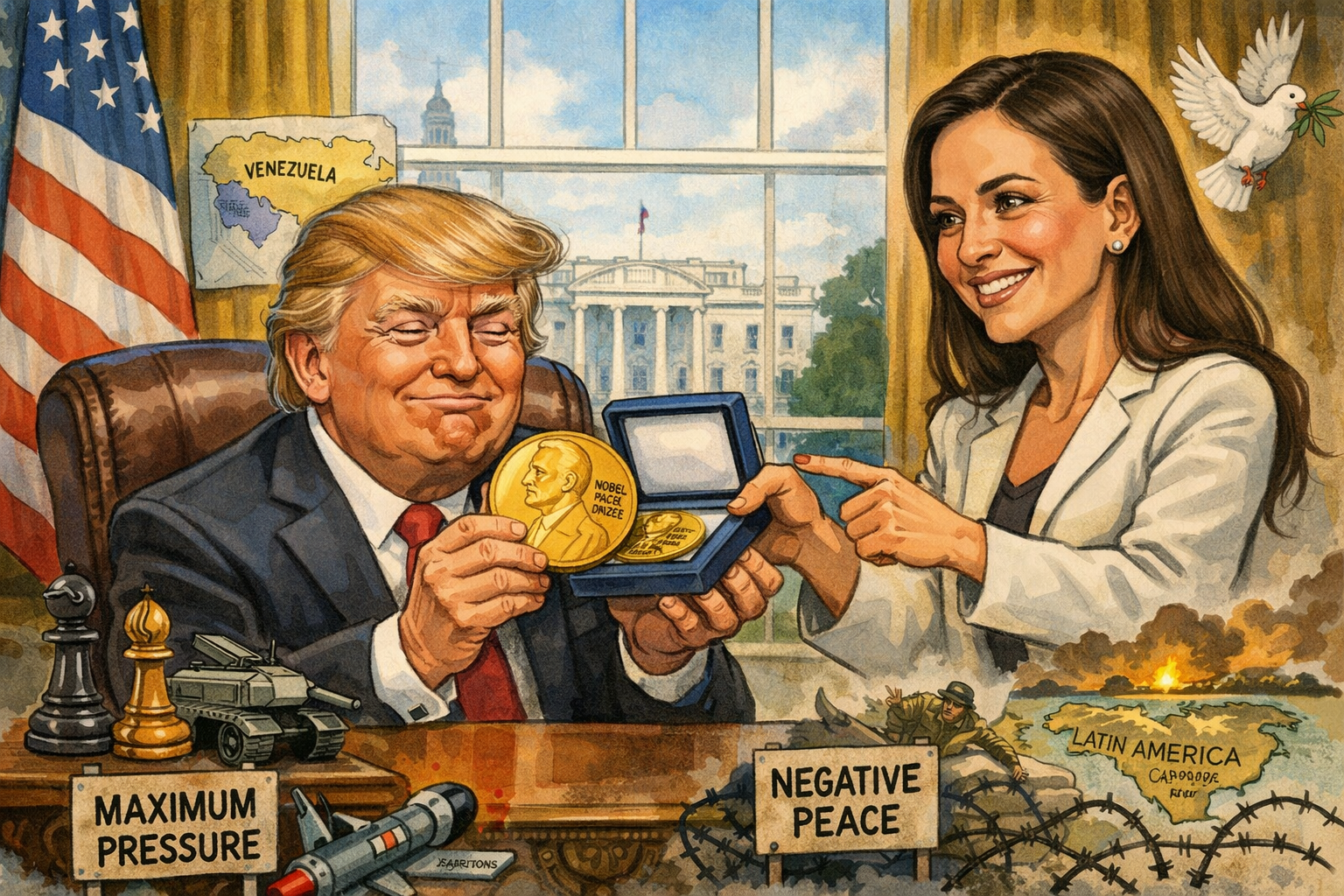
The presentation of a plaque titled Nobel Peace Prize by María Corina Machado to Donald J. Trump on 15 January 2026 at the Oval Office cannot be read as an ordinary ceremonial gesture. Despite lacking any formal institutional significance, the act produced a far more consequential political meaning: a reconfiguration of power relations between the Venezuelan opposition and the United States in the aftermath of the “maximum pressure” phase directed at the Nicolás Maduro regime.
During the Trump administration, the United States pursued a strategy of maximum pressure against Venezuela that effectively reshaped the country’s position within the international order. Diplomatic isolation, asset freezes, the delegitimation of the Maduro government, and exclusion from the global financial system placed Venezuela in a state of siege without opening the path to direct military intervention. This pressure functioned as a low-cost instrument of geopolitical control, allowing American dominance to be maintained without the risks of open warfare or significant domestic political burden.
Yet the criteria for success embedded in this strategy did not fully align with how the Venezuelan opposition interpreted political reality. For the most hardline opposition figures, including Machado, success was not measured by levels of international isolation or economic damage inflicted on the regime, but by a single concrete outcome: the end of Maduro’s rule. As long as political control in Caracas did not change hands, external pressure was understood as an unfinished process. This divergence in perspective created an early distance between Machado and Trump, at times positioning Machado as a figure demanding that Washington go further than the White House was willing to do.
It is within this context that the symbolic handover of the Nobel plaque must be understood. The act did not represent an ideological conversion, but rather a political repositioning. Machado was not reassessing Trump’s policies on normative grounds; she was renegotiating her position in relation to the global center of power. By bringing a symbol of peace into the Oval Office, she acknowledged that Trump’s strategy functioned effectively within the American framework, even if it failed to meet the maximal expectations of the Venezuelan opposition. The gesture became a political language through which the opposition implicitly affirmed that it had no alternative reference of power outside Washington.
For Trump, the moment served as a form of retrospective legitimization. Criticism that maximum pressure failed to produce regime change did not need to be answered through policy debate or technical evaluation. The presence of Machado and the symbol she delivered were sufficient to reframe the narrative: even the most uncompromising opposition figure ultimately came to offer recognition. In the realm of symbolic politics, such imagery often proves more effective than rational argumentation.
At the same time, Machado’s position reflected the increasingly constrained condition of the Venezuelan opposition itself. Electoral pathways were restricted, opposition forces were fragmented, and the locus of meaningful change shifted beyond national borders. In such circumstances, consistency in past criticism became less decisive than the ability to maintain access to global centers of decision-making. The symbolic act was not an expression of personal loyalty, but a manifestation of the opposition’s structural dependence on external power.
The events of 15 January 2026, therefore, were not about the Nobel Prize, nor about moral reconciliation. They constituted a post–maximum pressure political ritual, in which the opposition acknowledged the limits of its own power, while the United States reaffirmed its position as the ultimate arbiter in Venezuela’s political conflict. In global politics, meaning is often determined not by who falls, but by who remains the final point of reference.
Within the framework of negative peace, Donald J. Trump’s eligibility for a Peace Prize is not measured by the realization of social justice or comprehensive political reconciliation, but by his success in preventing the outbreak of open war and large-scale violence. Throughout his leadership, Trump favored a strategy of intense pressure combined with military restraint, an approach that consistently foreclosed the possibility of direct armed conflict even as geopolitical tensions escalated sharply.
In the Latin American context, policy toward Venezuela illustrates this logic with particular clarity. Maximum pressure was designed to cripple the regime’s capacity without transforming political conflict into regional war. By refraining from direct military intervention, the United States under Trump avoided scenarios of mass violence, cross-border displacement, and regional destabilization that would almost certainly have followed an open invasion. The peace produced was not positive peace that resolved the roots of conflict, but negative peace that kept the region below the threshold of war.
This approach signals an important shift in the practice of global peace. Trump did not seek to create international harmony or universal moral consensus; instead, he imposed clear limits of power while withholding total destruction. Within the logic of negative peace, the capacity to prevent conflict from escalating into open warfare becomes the primary measure of stability, even when political tension and structural suffering persist.
If the Nobel Peace Prize is understood as an award for preventing major wars, Trump’s record occupies a relevant category. He did not expand the list of American military invasions, did not open new theaters of war, and consistently kept conflicts within the realm of non-military pressure. Peace here is not an ideal condition free from oppression or inequality, but the absence of armed violence that would be far more destructive.
It is in this perspective that María Corina Machado’s symbolic presentation of the Nobel acquires its most precise meaning. The gesture reflects an acknowledgment that Trump’s strategy, however harsh and controversial, kept the Venezuelan conflict within the bounds of political and economic pressure rather than open war. The symbolic Nobel affirms a simple thesis: in a world saturated with conflict, negative peace is often the only form of peace that is politically attainable.


