

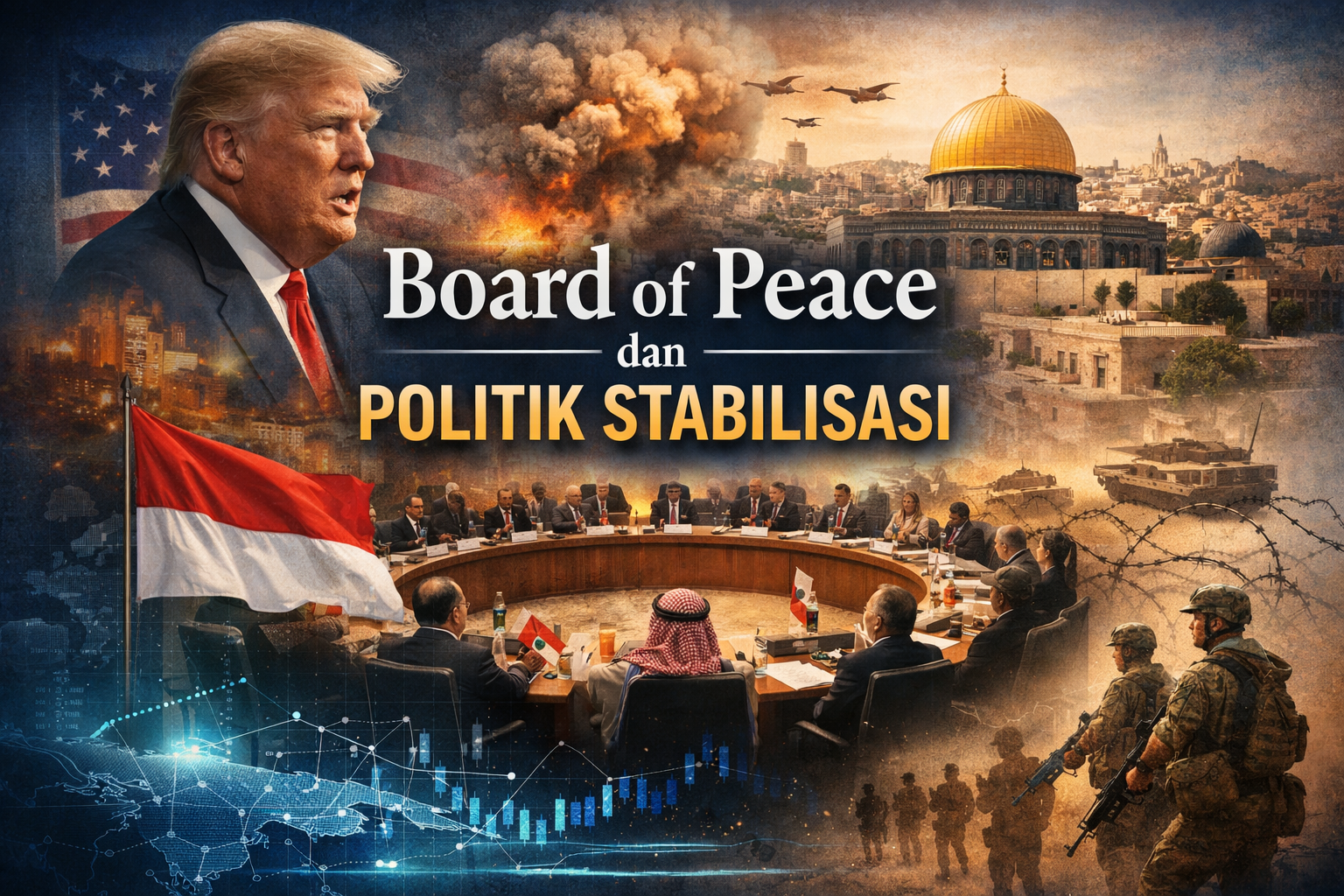
The origins of the formation of the Board of Peace cannot be separated from the fundamental transformation in the way the United States has managed international conflicts since the end of the Cold War, particularly following the prolonged experience of direct interventions that were costly and carried high risks in Afghanistan, Iraq, and Syria. During this phase, a strategic awareness emerged that large-scale conflicts are no longer resolved through total military victory, but rather through the control of escalation so that they do not develop into regional or systemic wars.
Under the leadership of Donald Trump, this approach was crystallized in the form of a flexible, non-institutional mechanism operating outside the formal structure of the United Nations Security Council and designed to function swiftly without the burden of multilateral consensus. The Board of Peace emerged as a response to the limitations of conventional international institutions in addressing acute conflicts, while also serving as an effort to create a security coordination space that allows the United States and its key partners to maintain regional stability without being bound to lengthy and often stalled diplomatic processes.
The global context surrounding the formation of the Board of Peace has been marked by increasing fragmentation in international security governance, particularly the declining effectiveness of the United Nations Security Council as an arena for rapid decision-making in acute conflicts. Polarization among permanent members, repeated use of veto power, and the inability to produce operational resolutions during armed crises have driven major powers to seek alternative mechanisms outside the formal multilateral framework.
At the same time, the escalation of conflict in the Middle East, rising tensions between the United States and Iran, and concerns over the potential spread of conflict to global energy and trade routes have created an urgent need for a more flexible and ad hoc coordination forum. In this situation, the Board of Peace has been positioned as a space for synchronizing key security interests, not to replace existing international institutions, but to close the temporal and procedural gaps that arise when official mechanisms are unable to respond to conflict dynamics at the speed required by the international system.
The operational differences between the Board of Peace and the United Nations Security Council lie primarily in decision-making structures, response speed, and the logic of legitimacy employed. The UN Security Council operates through formal procedures that rely on written resolutions, minimal consensus among permanent members, and universally recognized international legal legitimacy, but is often hampered by vetoes and prolonged negotiations. By contrast, the Board of Peace is designed as an ad hoc mechanism that does not depend on open voting or broad multilateral consensus, but instead on limited coordination among key actors with direct power capabilities.
Its operations emphasize speed, flexibility, and the ability to produce practical understandings without the immediate translation into international legal instruments. Within this configuration, the legitimacy of the Board of Peace does not derive from a universal mandate, but from its effectiveness in keeping conflicts within thresholds that can be managed by the international system. If taken further, this logic of stabilization does not emerge abruptly; rather, it is rooted in a long-standing tradition of American leadership that views the management of the world as both a moral responsibility and a strategic necessity.
Within this longer frame, the Board of Peace can be read as a contemporary transformation of the doctrine of Manifest Destiny. Whereas in the nineteenth century this doctrine legitimized American territorial expansion on the basis of moral calling and divine destiny, in the present context such expansion no longer takes the form of territory, but of normative authority to determine the form, timing, and limits of global peace. Peace is no longer produced as the outcome of conflict resolution, but as a regime of stabilization that keeps conflict within a threshold deemed manageable. In this logic, the Board of Peace functions as a mechanism for the secularization of an older mission: war is not abolished, but managed; violence is not rejected, but organized; and legitimacy no longer derives from conquest, but from moral claims over global stability.
The Board of Peace does not merely manage actors and the spatial dimensions of conflict, but also the temporal dimension of conflict itself. Through mechanisms of limited coordination and decisions that are not always publicly disclosed, the forum determines when a crisis should be accelerated, restrained, or allowed to linger in a condition of managed uncertainty. Within this configuration, time does not function as a neutral variable, but as an instrument of power. By controlling the tempo of escalation and de-escalation, stabilization does not simply maintain temporary order, but actively shapes the boundaries of political possibility: when peace may be articulated, when violence can be tolerated, and when public attention must be redirected.
Within this framework, the Board of Peace does not rest on a single doctrine, but rather on the convergence of several strategic traditions within American statecraft: exceptionalism, which claims a moral right to exemption; a preemptive logic that prioritizes preventing escalation before threats become systemic; and an orientation toward stability that places order above deep political transformation. Together, these elements shift the meaning of peace from a normative goal into an object of strategic management, where legitimacy is no longer derived from universal consensus, but from claims of effectiveness in keeping the world under control. Within this framework, the logic of stabilization does not remain at an abstract level, but finds its most tangible operational form in the practice of United States foreign policy under the leadership of Donald Trump.
What is often referred to as the Trump doctrine is not articulated in the form of a systematic policy document, but rather manifests as a practical rationality that prioritizes concrete outcomes over normative procedures, stability over consensus, and selective pressure over comprehensive conflict resolution. Within this rationality, conflict is not understood as an anomaly to be terminated, but as a strategic variable that must be managed so as to remain within a non-systemic threshold.
The Board of Peace can be read as a softened institutional articulation of this logic, namely a collective mechanism that enables conflict management to proceed rapidly, adaptively, and in a coordinated manner without reliance on formal multilateralism. In this sense, the forum does not represent a deviation from the Trumpian approach, but rather serves as a medium through which practices of conflict management based on effectiveness and control can operate within a framework that is more symbolically acceptable at the global level.
The official composition of the Board of Peace demonstrates that this mechanism was not constructed as an elite forum of major powers, but rather as a coalition of middle and regional states spread across different regions, ranging from Eastern Europe and the Balkans such as Albania, Kosovo, and Belarus; Latin America such as Argentina, Paraguay, and El Salvador; to Central Asia and Southeast Asia such as Kazakhstan, Uzbekistan, Mongolia, Vietnam, and Indonesia. In the Middle East, the presence of key actors such as Egypt, Jordan, Qatar, Saudi Arabia, the United Arab Emirates, Turkey, and Bahrain indicates that the Board of Peace was designed to concentrate states with functional positions in regional stability, rather than veto-holding states or traditional hegemonic powers.
The absence of major powers such as China and Russia, as well as the minimal involvement of Western Europe, underscores that this forum operates as an alternative stabilization architecture: a network of states sufficiently diverse to create an impression of global legitimacy, yet sufficiently controlled to enable rapid coordination under United States leadership. In such a configuration, the Board of Peace is not intended to represent the world order, but to manage conflicts through the distribution of stabilization responsibilities among politically adaptive states that are not bound by the structural deadlock of classical multilateralism.
The attitudes of states that were invited but chose to delay their decisions or explicitly declined to join the Board of Peace reveal the structural limits of this mechanism as a producer of peace. Delay is not a neutral position, but a form of strategic calculation by states with high levels of sovereign capacity that recognize participation in the Board of Peace as not merely symbolic, but as an implicit acknowledgment of a security leadership architecture centered on the United States. States such as China, Russia, and India are not rejecting peace itself, but rather rejecting a format of peace that separates strategic decision-makers from supporting participants.
Meanwhile, open rejection by several Western European states reflects unease over the erosion of established multilateralism, as the Board of Peace is perceived as a mechanism that could replace collective processes based on international law with selective coordination driven by power and speed. In this configuration, the greater a state’s strategic autonomy, the stronger its tendency to keep distance, because the Board of Peace offers controlled stability rather than peace negotiated on an equal footing. Thus, patterns of delay and rejection are not merely variations in diplomatic posture, but indicators that the Board of Peace functions effectively as a limited conflict management instrument, while facing inherent resistance when claimed as a framework for global peace.
The central paradox of the Board of Peace lies in the fact that the states most needed to sustain long-term peace are precisely those that choose to remain distant from the mechanism. Major states with substantial material, political, and symbolic capacities such as China, Russia, and India understand that short-term stability can be produced through limited coordination, but sustainable peace requires involvement in rule-making, not merely participation in implementation. The Board of Peace offers a fast and efficient space for conflict management, yet its concentrated leadership structure and narrow deliberative space implicitly confine major powers to reactive rather than constitutive roles.
For these states, joining would mean accepting a peace order already determined, rather than shaping its architecture. This is why they do not reject peace itself, but delay or refuse a peace format that does not provide an equal role in the production of norms and global legitimacy. This paradox shows that while the Board of Peace is effective in preventing conflicts from erupting systemically, it simultaneously faces resistance from major actors who view peace as a long-term process that must be built through the distribution of power, not merely through stabilization coordination.
Within the framework of Donald Trump’s leadership, what is often referred to as a black project is more accurately understood as a non-conventional method of conflict resolution deliberately placed outside the procedures of UN multilateralism and normative diplomacy. This pattern appears consistently across several cases. In the normalization of relations between Israel and Arab states through the Abraham Accords, Trump did not rely on international resolutions or lengthy UN processes, but on a combination of bilateral pressure, economic incentives, and closed negotiations whose outcomes were announced only once agreements had fully matured. In the case of Iran, the killing of Qasem Soleimani demonstrated the use of limited and highly precise operations as strategic messaging rather than open war escalation, accompanied by diplomatic rhetoric designed to restrain retaliatory responses.
A similar approach was evident in pressure against Venezuela, where economic sanctions, intelligence operations, and political maneuvers operated in parallel without conventional military escalation. Even in relations with North Korea, Trump combined overt diplomatic symbolism with continued security and economic pressure behind the scenes. These examples show that for Trump, peace is not the product of international procedural consensus, but of a combination of non-public actions, calibrated pressure, and the management of public perception. In this context, the Board of Peace can be read as a logical extension of this method, providing a platform for public stability and coordination while substantive conflict resolution is carried out through non-conventional channels deliberately kept outside formal UN mechanisms.
This non-conventional approach under Donald Trump finds its clearest relevance when applied to the context of Gaza, where armed conflict, humanitarian pressure, and global geopolitical sensitivities converge within a narrow space. In the case of Gaza, the black project method does not operate as a single spectacular operation, but rather as a series of limited actions running parallel to a public stabilization narrative. While forums such as the Board of Peace work to prevent the conflict from immediately expanding regionally and to maintain international perception control, non-public channels operate through security coordination, assessment of non-state actors’ responses, and the recalibration of pressure balances involving Israel, Hamas, and other regional actors.
This pattern resembles Trump’s earlier practices, in which conflicts are not resolved through one grand agreement, but through the accumulation of incremental steps that alter the cost–risk calculations of the parties involved. Gaza, in this framework, becomes a laboratory for limited conflict management rather than an arena for normative reconciliation. This helps explain why some states are willing to join the Board of Peace due to the perceived benefits of short-term stability, while major powers maintain distance because they read the substantive resolution of the Gaza conflict as being driven more by non-conventional mechanisms that lack full transparency and are not bound by formal UN procedures.
The primary controversy attached to the Board of Peace lies not in its intentions or peace rhetoric, but in its structural implications for global security governance. By operating outside the formal mechanisms of the United Nations Security Council, the Board of Peace effectively shifts the center of decision-making from rule-based multilateral spaces to limited coordination networks controlled by a small number of actors. For its supporters, this model is seen as more responsive, adaptive, and realistic in confronting acute conflicts such as Gaza. For its critics, however, the mechanism sets a dangerous precedent by normalizing conflict management without universal mandate, full transparency, or collective accountability.
This controversy is further sharpened by the fact that the Board of Peace does not formally replace the UN Security Council, but operates in parallel, creating ambiguous overlaps of authority between short-term political stability and long-term international legal legitimacy. Under such conditions, the question is no longer whether the Board of Peace can maintain temporary calm, but whether the proliferation of ad hoc security mechanisms gradually shifts the meaning of peace from the product of global consensus to the outcome of limited power coordination.
Despite the harsh criticism and even emotional rejection directed at Donald Trump’s non-conventional approach, the paradox lies in the international system’s need for such a type of leadership under conditions of frozen and deadlocked conflicts. When formal multilateral mechanisms suffer procedural paralysis, repeated vetoes, and an inability to produce rapid operational decisions, Trump’s conflict resolution model offers something rarely available in normative diplomacy: the capacity to directly and measurably alter actors’ risk calculations.
The world may not require Trump as a moral symbol of peace, but it requires his capacity to force transitions from escalation to stabilization through pressure, incentives, and decisions unconstrained by broad consensus. In this context, critiques of Trump’s style often fail to distinguish between normative discomfort and functional effectiveness. The Board of Peace, with all its controversies, reflects a latent systemic need for figures willing to operate outside the idealized UN framework to prevent conflicts from moving toward broader destruction.
Within such a configuration, Indonesia’s decision to be part of the Board of Peace should not be read as a normative stance on peace, but as a strategic choice laden with risk. On one hand, Indonesia’s presence provides access to a narrower and faster coordination space than formal multilateral mechanisms, allowing Indonesia to influence stabilization tempo and safeguard domestic interests from the spillover effects of the Gaza conflict. On the other hand, the centralized and low-transparency architecture of the Board of Peace exposes Indonesia to the risk of becoming symbolic legitimacy for the security strategy of the directing actor, without assurance that substantive conflict resolution will occur.
It is at this point that the pros and cons intersect sharply. Indonesia may enhance its diplomatic weight if it can convert membership into a tool of concrete leverage, but it also risks losing moral standing if the forum produces only perception management without material change on the ground. Thus, the significance of Indonesia’s participation is determined not by its membership status, but by the extent to which Indonesia can shift the Board of Peace from a mere instrument of political stabilization into a space that generates tangible consequences, a test that will determine whether Indonesia emerges as an agenda-setting actor or merely part of a global calming architecture.
At this stage, domestic opposition to Indonesia’s involvement in the Board of Peace reflects a natural tension between moral positioning and strategic calculation. Concerns that participation might be interpreted as weakening solidarity with Palestine or legitimizing a security mechanism that lacks full transparency cannot be dismissed. At the same time, precisely because the issue is saturated with values and public pressure, Indonesia requires presence within the conflict management process to avoid being confined to rhetorical positioning alone.
In an international environment increasingly shaped by limited coordination outside formal forums, remaining outside means forfeiting opportunities to influence stabilization trajectories. Here the paradox becomes evident. Domestic aspirations demanding moral firmness actually require more active strategic presence rather than withdrawal. Indonesia’s challenge is not to choose between morality and strategy, but to ensure that its participation in the Board of Peace is used to bring humanitarian concerns and foreign policy priorities into real decision-making spaces, rather than becoming merely part of a symbolic architecture.
One aspect that rarely appears in media coverage is that Indonesia’s involvement in the Board of Peace also engages the simultaneous management of time, information, and risk. The forum does not merely distribute diplomatic roles, but regulates conflict tempo, determining when pressure is intensified, restrained, or redirected before major decisions are publicly announced. By being inside, Indonesia does not only state its political position, but enters the circulation of strategic information that shapes stabilization directions from early stages.
At the same time, domestic resistance and unease actually strengthen Indonesia’s maneuvering space, as public pressure limits how far the state can be drawn into decisions carrying high moral and reputational risks. In this configuration, Indonesia’s presence goes beyond symbolism or normative statements and functions as a risk management instrument, where insider positioning and critical distance from domestic pressures operate together to protect national interests without sacrificing ethical consistency.
In practice, Indonesia does not merely participate as a member, but also performs a function of moral legitimation within an externally driven architecture of stabilization. Indonesia’s presence, shaped by its Global South standing, its non-aligned political legacy, and domestic sensitivities surrounding the Palestinian issue, adds normative weight to a mechanism oriented toward strategic stability. This position places Indonesia in an ambiguous space, symbolically important yet limited in its ability to shape the direction of decisions. The central challenge, therefore, is not passive involvement, but ensuring that such presence does not remain confined to a purely symbolic function.
The Board of Peace should thus be situated not as a final answer to global conflict, but as a symptom of changing modes of managing tension amid multilateral deadlock. Under Donald Trump’s leadership, peace is not produced through universal consensus, but through measured stabilization, selective pressure, and international perception management. In this context, Indonesia’s choice to be inside the Board of Peace is not a moral compromise, but a strategic recognition that absence would only narrow its sphere of influence.
Yet such presence carries meaning only insofar as Indonesia can maintain critical distance, inject humanitarian concerns into real decision-making spaces, and resist being reduced to a symbol of legitimacy. The final question is not whether the Board of Peace can bring peace to the world, but whether states within it are willing to bear political risk to transform temporary stabilization into more substantive responsibility for peace.


