

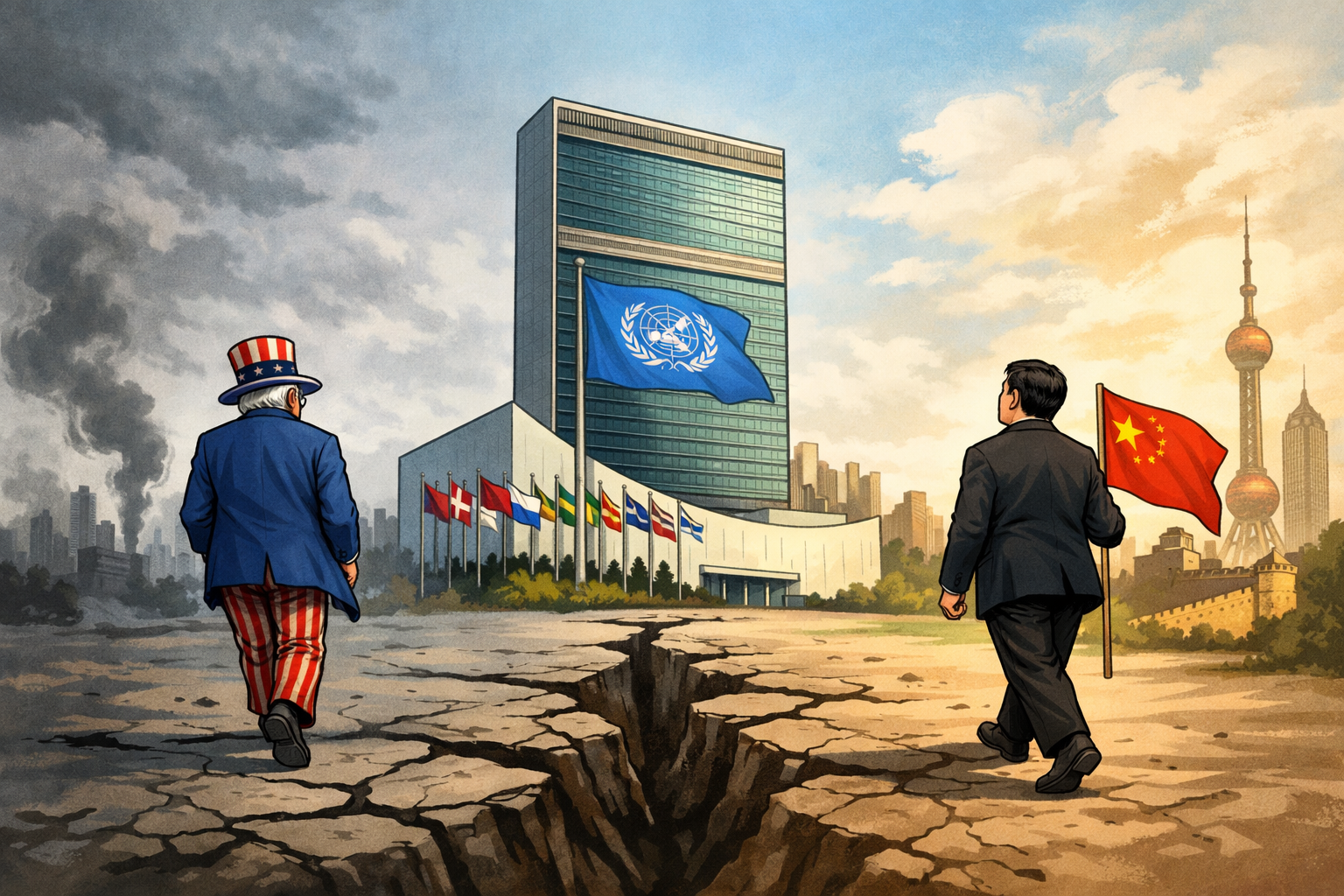
On February 15, 2026, at the Munich Security Conference in Germany, a debate about the future of the global order emerged through two statements that subtly yet clearly confronted one another. United States Secretary of State Marco Rubio stated that the post–World War II international order needs to be reformed because states can no longer place what he called the “global order” above the vital interests of their people and nations. He also argued that the United Nations still has the potential to be a force for good, but that so far it “has no answers and has played almost no role” in addressing the most urgent global crises, including the conflicts in Ukraine and Gaza. At the same forum, Chinese Foreign Minister Wang Yi emphasized the opposite position, stating that the United Nations, as one of the principal outcomes of victory in World War II, must be strengthened rather than weakened. According to him, without the United Nations the world would return to a situation of “the law of the jungle, where the strong prey on the weak,” and small and medium-sized states would lose the foundation for their survival and development. These two statements reveal not only differences in attitudes toward the effectiveness of the UN, but also different ways of understanding the function of global institutions within a changing structure of international power.
The United Nations was born from the traumatic experience of World War II as an effort to build a collective mechanism to prevent recurring global conflict. Since its establishment in 1945, the organization has functioned not only as a forum for diplomacy but also as an infrastructure of international legitimacy connecting international law, collective security, and global economic-political cooperation. The Security Council, with five permanent members holding veto power, reflects the global distribution of power at that time while serving as a mechanism for managing conflict among major powers. In this framework, the UN was never fully intended to eliminate rivalry among states, but rather to provide an institutional space to contain that rivalry so that it would not develop into systemic war. For decades, the existence of the UN became an important part of international stability, not because of its ability to resolve all conflicts, but because it provided a structure of global coordination that granted legitimacy to both collective and national actions within the international system.
However, in recent decades, United States confidence in the effectiveness of multilateral mechanisms represented by the United Nations appears to have declined. Rubio’s criticism that the organization “has played almost no role” in addressing major conflicts reflects broader frustration with Security Council deadlock, particularly when veto power makes collective decisions difficult to achieve. From the perspective of power politics, this situation reveals tension between global institutions built within the post-1945 configuration of power and contemporary geopolitical realities that are far more complex. The United States, once the principal architect of modern international institutions, now faces conditions in which those institutions cannot always be effectively used to support its strategic interests. Criticism of the UN therefore does not merely reflect rejection of multilateralism, but also signals a shift in America’s position within the international system, from builder of global order to an actor that must negotiate within an increasingly multipolar distribution of power.
By contrast, China places the United Nations as an important foundation of international stability that must be preserved. Wang Yi’s statement that the organization must be strengthened reflects China’s strategic interest in maintaining global institutional order that provides space for developing countries and emerging powers to participate in world governance. As a permanent member of the Security Council with veto power, China holds a position that is not only symbolic but also operational in global decision-making processes. In this context, defending the UN is not merely normative, but also related to efforts to maintain an international structure in which the distribution of power proceeds through institutional mechanisms rather than direct confrontation. For China, the existence of the UN provides a relatively stable framework of legitimacy for the rise of new powers in the international system, while preventing the return of international relations patterns determined entirely by unilateral military and political dominance.
The difference in positions between the United States and China regarding the United Nations ultimately reveals changing relations between power and institutions in the international system. Global institutions such as the UN do not stand outside power politics, but are always connected to the configuration of forces that sustain them. When the United States stood at the peak of its hegemony after World War II, the UN functioned as both an instrument of stabilization and a source of legitimacy for its global leadership. However, as the global distribution of power becomes more diffuse, the function of the institution also changes. The United States increasingly sees the limitations of the UN as an effective decision-making mechanism, while China sees it as an institutional space that strengthens the stability of global power transition. Thus, debate about the UN is not merely about the effectiveness of an international organization, but about how major powers adjust their strategies to a global order no longer fully determined by a single center of power.
Within the framework of hegemonic theory, this dynamic can be read as a sign of a slowly shifting crisis of global leadership. International institutions essentially emerge from political consensus shaped by dominant powers in a particular historical period. During the second half of the twentieth century, the legitimacy of the United Nations was largely sustained by the ability of the United States to maintain stability in the international system through a combination of military, economic, and institutional power. When that capacity faces new challenges, the legitimacy of global institutions also comes under pressure. This situation does not necessarily lead to the collapse of international institutions, but creates tension between the need for collective mechanisms and the growing tendency of major powers to act unilaterally or through limited coalitions. In this context, the statements of Rubio and Wang Yi can be understood as reflections of two different strategies in responding to changes in the global structure of power.
From a post-hegemonic order perspective, this dynamic shows that the international system is moving from a period of single leadership toward a phase in which no single state is able to fully determine the direction of global institutions. During the period of United States hegemony after World War II, the United Nations functioned as an institutional instrument relatively aligned with American global leadership. But as the distribution of global power becomes more dispersed and strategic competition intensifies, the relationship between major powers and global institutions also changes. The United States increasingly views the UN as a mechanism no longer capable of responding quickly and effectively to geopolitical conflicts, while China sees the same institution as an important framework of stability in managing global power transition without direct confrontation. In such post-hegemonic conditions, the UN does not lose its existence, but loses its position as an unquestioned center of coordination. It remains a necessary global forum, but its authority increasingly depends on negotiation and compromise among major powers that no longer exist within a single, stable structure of global leadership.
In a post-hegemonic situation, the United Nations increasingly functions not as a decisive conflict-resolution mechanism, but as an institutional space for managing tensions among major powers. When hegemonic consensus is no longer available, global institutions tend to operate as arenas of symbolic negotiation that maintain minimum stability in the international system. Security Council deadlock in various major conflicts demonstrates the limitations of the UN’s capacity to act collectively, but at the same time confirms that major powers still need an institutional forum capable of preventing strategic rivalry from escalating uncontrollably. In this context, the continuity of the UN is determined not solely by its operational effectiveness, but by the structural need of the international system for global coordination mechanisms, especially when no single power is capable of replacing the stabilizing function once performed by United States hegemony.
Imagining the future of the United Nations without active United States involvement does not mean the institution will collapse, but that it will experience a shift in the orientation of power within it. In conditions where the United States becomes increasingly selective toward multilateralism, the role of other states, particularly China, becomes more important in sustaining the institutional function of the UN. China has a strategic interest in maintaining the continuity of this organization because the UN provides an international legitimacy framework for global trade stability, economic development, and the principle of state sovereignty that has long been the foundation of its foreign policy. With large economic capacity and permanent membership in the Security Council, China has the potential to become a principal supporter of global institutional continuity, even without fully replacing the historical role of the United States as architect of international order.
However, a UN sustained by Chinese support would differ from the UN in the era of American dominance. Its institutional orientation would likely shift from emphasis on normative intervention toward sovereignty stability and economic development as primary priorities. In such circumstances, the UN may function as a more pragmatic mechanism of global coordination, with legitimacy no longer resting on single leadership but on balance among several major powers. The future of the UN therefore depends not on the presence of a particular state, but on the institution’s ability to adapt to an increasingly multipolar distribution of global power, in which China becomes one of the principal actors in sustaining international governance structures.
The greatest paradox of this possibility is that an international institution born from liberal United States leadership may endure precisely through the support of a power not built upon the same liberal tradition. If this dynamic continues, the United Nations may persist as a structure of global governance, but with a normative orientation different from that of its early formation. The principles of stability, sovereignty, and economic development may become more dominant than the agendas of democratization and humanitarian intervention that once formed an important part of the legitimacy of the post-1945 global order. In this context, the future of the UN is determined not by its existence as an organization, but by the transformation of the values and political rationality that sustain it. The same institution may endure, but its political meaning will no longer be identical to the international order once shaped by the United States.


