

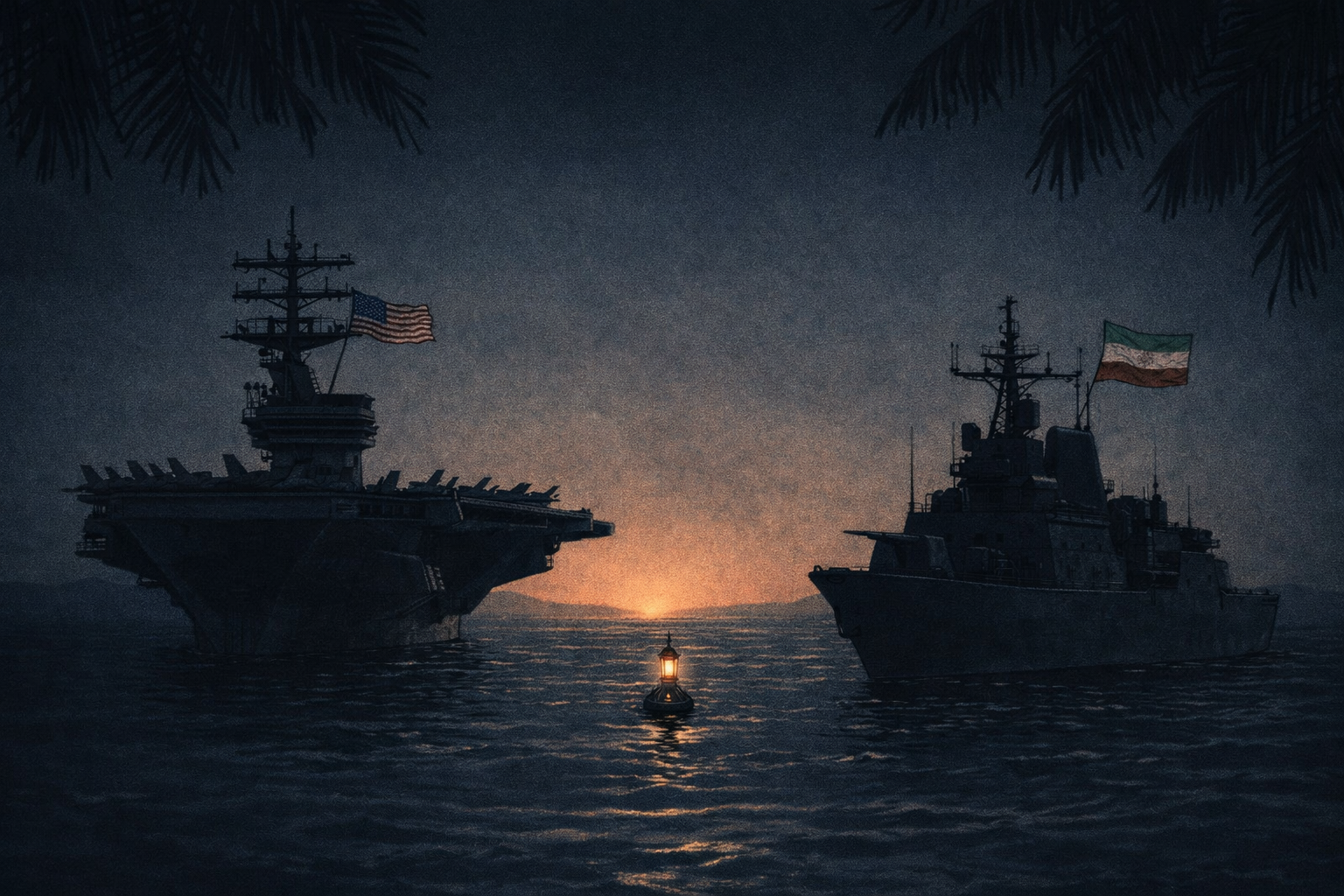
Over the past several weeks, three geopolitical currents have moved simultaneously yet are often read in isolation. First, the escalation of United States military indicators toward Iran. Second, the activation of a mechanism known as the Board of Peace in the management of the Gaza conflict. Third, the intensification of Western diplomacy toward China through high-level visits by Canada and the United Kingdom. Read separately, these developments appear as standalone events. Read structurally, however, they form a coherent architecture of conflict governance: a limited war being prepared while ensuring that the international system remains calm and controlled.
The escalation toward Iran follows a classic pattern preceding the use of force. The U.S. military posture has been strengthened through the deployment of the aircraft carrier USS Abraham Lincoln to the CENTCOM area of responsibility, accompanied by reinforcements in air assets and support systems. This move does not stand alone; it is paired with ultimatum rhetoric from President Donald Trump that places Iran before a binary choice: accept a new agreement or face more severe consequences. In the practice of international relations, the combination of tangible military deployment and public ultimatum language is not symbolic pressure, but an instrument designed to open a credible space for military decision-making.
Yet every option for attack requires more than technical readiness. It demands a stable international environment so that escalation does not spiral into a multi-front conflict. It is at this point that the approach described as peace on board becomes relevant. Peace in this framework is not understood as the resolution of root causes, but as the management of actors so that the system continues to function without major disruption.
The establishment of the Board of Peace for Gaza makes this logic explicit. Gaza is not treated as a question of politics or sovereignty, but managed as a space of risk. Regional actors are not positioned as decision-makers shaping political outcomes, but as managers of humanitarian aid, logistics, and stability. Israel is positioned as the enforcer of security order, while Arab states serve as buffers to prevent the conflict from expanding. The international community is directed to act as donors and providers of procedural legitimacy. In this configuration, peace is defined as the absence of escalation, not as justice or reconciliation.
This model of managing Gaza is not an isolated case, but a prototype. It demonstrates how conflict can be institutionally pacified so as not to disrupt larger strategic agendas. The presence of states from the Middle East and the Gulf such as Saudi Arabia, Qatar, the United Arab Emirates, Kuwait, Bahrain, Jordan, Egypt, and Türkiye as regional buffers; Central Asia through Kazakhstan and Uzbekistan as non-confrontational balancing zones; South Asia through Pakistan; Southeast Asia through Indonesia, Cambodia, and Vietnam; East Asia through Mongolia; Latin America through Argentina, Paraguay, and El Salvador as sources of Global South legitimacy; and Eastern Europe and the Balkans through Albania, Bulgaria, Hungary, Kosovo, Belarus, Armenia, and Azerbaijan as representations of non-core Europe, together form a network of calm capable of absorbing regional and global resonance.
It is here that Western diplomacy toward China acquires its meaning. The visit of the Canadian Prime Minister to Beijing, followed by that of the British Prime Minister, is not merely a bilateral economic agenda. Timing and context are critical. Both visits took place amid rising escalation toward Iran and as the Board of Peace began to be institutionalized as a global mechanism. This diplomacy functions as a buffer, not as a covert transaction, but as a means of managing China’s position so that it remains within a regime of stability.
The fact that Canada and the United Kingdom are not members of the Board of Peace in fact strengthens their function in this context. Remaining outside the structure allows both countries to speak with Beijing without carrying the institutional burden of a mechanism perceived as a unilateral U.S. initiative. This formal detachment gives Canada and the UK diplomatic flexibility to employ pragmatic language about stability, trade, and strategic caution without having to defend or legitimize the Board of Peace itself. In this configuration, both appear not as extensions of the conflict-management architecture, but as actors that retain a degree of autonomy, making them more readily accepted by China as dialogue partners not directly associated with escalation toward Iran.
China does not need to be persuaded to support an attack on Iran. What is required is ensuring that China does not transform the Iran issue into a systemic challenge to the global order. Through active communication channels, pragmatic language, and economic cooperation, China is encouraged to maintain its role as a stabilizing actor. China’s calls for restraint and dialogue are not expressions of hard opposition, but manifestations of a managed role. China speaks, but within limits that do not obstruct U.S. operational space.
The selection of Canada and the United Kingdom as messengers is also not incidental. The United States itself is too closely associated with escalation. These middle powers function as legitimacy managers: close enough to Washington to be trusted, yet moderate enough to maintain dialogue with Beijing. They reduce the likelihood of a countervailing bloc forming at the United Nations, in energy markets, or in international public opinion, without the need to construct explicit agreements regarding Iran. In the history of U.S. foreign policy, managed neutrality from major actors has often been considered a sufficient prerequisite.
When read through a framework of sign systems, what operates here is not only material power, but the production of meaning. The Board of Peace is a sign that transforms the Gaza conflict from a political question into one of governance. The ultimatum toward Iran is a sign that converts potential aggression into rational enforcement of compliance. The deployment of an aircraft carrier is a sign of readiness that simultaneously locks in a narrative whereby escalation, if it occurs, is framed as the consequence of Iran’s own choices. Within such a regime of signs, war does not need to be justified as moral good, only as technical necessity.
Thus, the relationship between Gaza, China, and Iran is not directly causal, but structural. Gaza is managed so as not to disrupt regional stability. China is managed so as not to disrupt systemic stability. Iran is pressured through a combination of ultimatum and military readiness. All three are situated within the same architecture: a limited war prepared at one point, while calm is actively maintained elsewhere.
The most reasonable conclusion is not that the West has reached a secret agreement to attack Iran, but that the space for such an option is being opened and safeguarded. Peace on board is not a promise of peace, but a technique for managing actors so that the global ship continues to sail smoothly, even as one section of the deck is being prepared for conflict. In contemporary conflict governance, calm is not the absence of war, but the condition that allows war to be conducted without shaking the entire system.
If these indicators continue to move in the same direction, what we are witnessing is not a failure of diplomacy, but its success in its coldest form: diplomacy as the management of conditions for controlled violence.


