

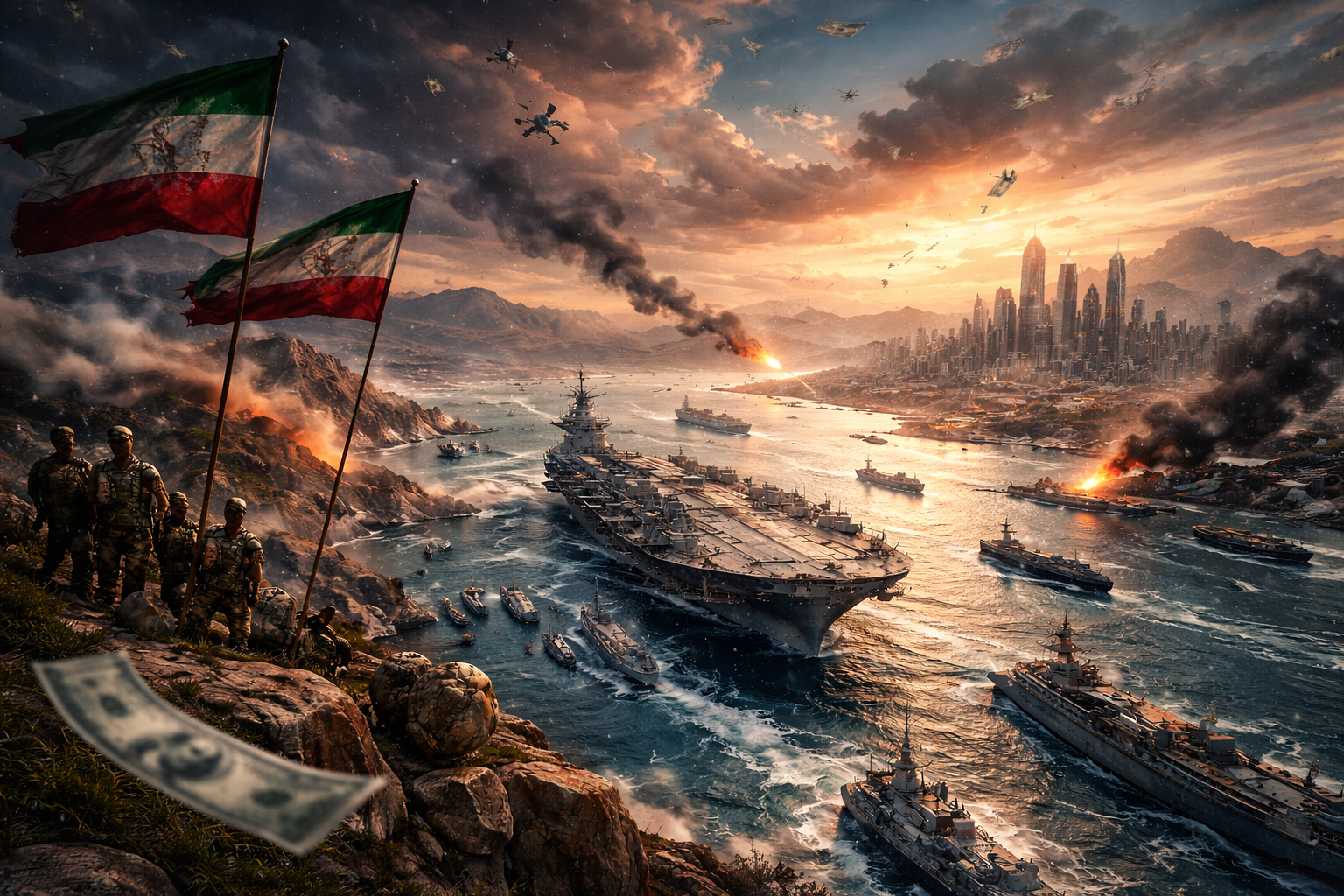
On 28 February, within a span of measured and coordinated hours, the United States launched Operation Epic Fury as a high-intensity precision campaign that simultaneously targeted Iranian strategic installations associated with missile capabilities and defense infrastructure. The strike was not a sporadic escalation, but a demonstration of supremacy in power projection possessed by only a handful of actors in modern history: the capacity to integrate long-range bombers, fifth-generation combat platforms, real-time surveillance systems, and cross-regional unified command within a single operational cycle that was brief yet systemically consequential. Within hours of the first wave, several high-value targets were reported neutralized, regional airspace experienced partial closures, commercial flight routes were diverted, and energy markets reacted with sharp volatility, signaling that the effects extended beyond the strictly military domain. What rendered this moment significant was not only the level of precision and coordination, but the fact that within an extremely limited timeframe Washington was able to create new strategic facts on the ground while compelling the international system to respond. Operation Epic Fury thus revealed a form of spectacular power not previously articulated with such density in contemporary history: an operation lasting only hours that not only struck physical targets, but also shifted regional geopolitical calculations and retested the hierarchy of global power.
Within hours following the 28 February wave of attacks, the results of Operation Epic Fury extended beyond the degradation of military infrastructure and reached the core of Iran’s strategic leadership. Iranian state media confirmed the death of Supreme Leader Ayatollah Ali Khamenei, making the operation a direct blow against the highest authoritative figure within the political and religious structure of the Islamic Republic. At nearly the same time, several reports indicated that Defense Minister Amir Nasirzadeh and Islamic Revolutionary Guard Corps commander Mohammad Pakpour were among the senior officials killed. Statements from the Israeli military also suggested that several other senior commanders, including Ali Shamkhani, known as a close adviser within the inner circle of power, were among the casualties. Read as a sequence, the operation that lasted only several hours produced an impact that, in strategic military terminology, may be categorized as a decapitation strike: the severing of leadership nodes in a short period in order to create command disorientation, an authority vacuum, and a slowdown of response capacity before retaliatory consolidation can fully form.
The simultaneous elimination of these top figures transformed the meaning of the operation from a kinetic act into an intervention against the architecture of power. When the center of political, military, and religious authority is disrupted in a single concentrated momentum, what is affected is not merely individuals, but the entire configuration of legitimacy and the command mechanisms that sustain it. In a state structure grounded in ideological hierarchy and centralized decision-making, deaths at the highest level generate a normative vacuum alongside internal competition that slows strategic cohesion. At this point, American power appears not merely as technological superiority and operational precision, but as the capacity to interrupt the institutional rhythm of its adversary and to impose an accelerated phase of transition. An operation conducted within hours thus produced effects that ordinarily require a prolonged campaign: disruption of the chain of authority, recalibration among elites, and the reordering of policy orientation under external pressure not yet fully managed. Operation Epic Fury therefore functioned not only to alter the military balance, but to restructure the internal political landscape and to project hegemonic determination within the international system.
Yet the power embodied in Operation Epic Fury did not end with precision explosions and the severing of command chains; it continued through the production of global acceptance. When the United Kingdom opened access to its bases for defensive American operations, when Germany aligned its political statements with Washington’s strategic objectives, and when France moved the aircraft carrier Charles de Gaulle into the Mediterranean as a signal of readiness, what emerged was not merely military or diplomatic support, but a network of legitimacy. Within that network, power operates not only through destructive capacity, but through normalization. American action was repositioned as stabilization rather than aggression; as security management rather than expansion. The support of the E3 transformed a military event into an acceptable political truth, because collective recognition by key European states shifted the boundary between what is considered legitimate and what is deemed excessive.
Here, power operates productively. It does not merely repress or destroy, but produces categories, shapes perception, and disciplines international discursive space. Joint statements, defense coordination, and symbolic deployments such as the French aircraft carrier constructed a landscape of meaning in which the operation was understood as a rational act within a framework of shared security. Even calls for restraint did not negate the legitimacy of the initial action; rather, they reinforced the image that the Western bloc continued to operate within norms of proportionality. Operation Epic Fury thus demonstrates that modern dominance no longer rests solely upon weapons superiority, but upon the capacity to integrate kinetic force with the production of consensus, enabling organized violence to appear as justifiable security governance within the international order.
China’s involvement in the post–28 February dynamics was not expressed through open military escalation, but through a measured strategic repositioning within the global power structure. Beijing emphasized sovereignty, de-escalation, and regional stability, while strengthening diplomatic communication with Tehran and key actors in the Gulf whose significance is directly tied to China’s energy security. This posture reflects a deeper structural calculation: China has no interest in allowing the United States to monopolize the definition of regional security, yet it also seeks to avoid kinetic confrontation that could destabilize the global economy and the trade routes sustaining its interests. Chinese power therefore operates through narrative management, market stabilization, and perception control, positioning itself as a systemic balancer without direct military entry. In this context, Operation Epic Fury compelled not only Iran and the E3 to recalibrate, but also tested Beijing’s ability to maintain influence within an order being reconsolidated through American demonstration of force.
Operation Epic Fury did not merely create a leadership vacuum and consolidate Western alliances; it also opened a new phase in the logic of deterrence. The several-hour demonstration of force sent a message that the United States is capable of precise penetration into the core of a target state’s power structure. Yet within asymmetric conflict structures, such action often does not close a conflict, but transforms it. Iran, having lost central figures and experienced command disruption, may shift its response from conventional patterns toward a non-linear spectrum: proxy operations, maritime pressure in the Strait of Hormuz, cyberattacks, or the mobilization of regional networks. The paradox of deterrence thus reemerges: the more spectacular the demonstration of force, the greater the incentive for the pressured actor to prove that it is not incapacitated. At this juncture, Operation Epic Fury ceases to be merely a military event and becomes a long-term test of international system stability.
Accordingly, although new leadership has formed through constitutional mechanisms and Iran has demonstrated institutional continuity, Operation Epic Fury cannot yet be read as a closed episode; rather, it opens an unfolding chapter in which the Strait of Hormuz becomes the most sensitive arena for the next demonstration of power. In the context of an ongoing war, every concentration of fleets, increase in maritime patrols, or disruption of global energy routes carries the potential to transform this operation from a precision land strike into a spectacular confrontation at one of the world’s most strategic chokepoints. What is at stake, therefore, is not only Iran’s stability, but the security of international energy arteries and the credibility of American power in managing escalation at one of the most vital nodes of global geopolitics.


