

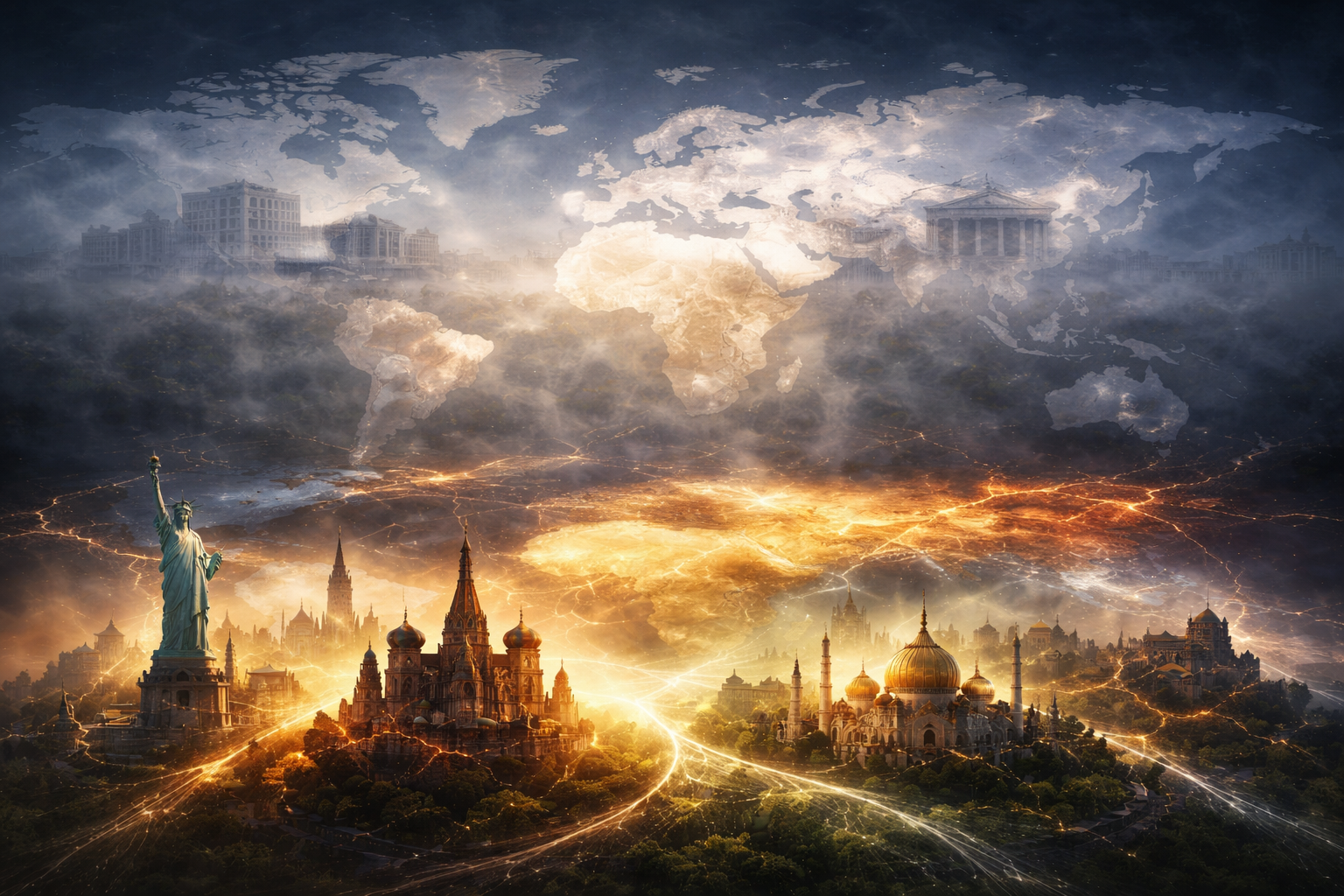
After the fall of the Berlin Wall in 1989, the world moved with the conviction that the liberal order would become the main direction of global politics. The end of the Cold War was understood not only as a geopolitical victory for the West, but also as a triumph of liberal democracy and the market economy. This belief was reinforced by Francis Fukuyama’s thesis on the “end of history,” which argued that liberalism represented the final form of ideological development in human political life. Since then, the world seemed to follow the assumption that democracy, free markets, and international institutions were the natural foundations of the future of global civilization.
Criticism of this belief emerged from Samuel Huntington, who argued that optimism about the victory of liberalism oversimplified global political reality. In his thesis on the clash of civilizations, he contended that future conflicts would no longer be primarily determined by ideology or economics, but by cultural and civilizational identity. The world, in his view, was not moving toward liberal uniformity, but toward a plurality of civilizations with different histories, values, and systems of meaning. Thus, rather than witnessing the end of history, global politics was entering a new phase in which civilization became the principal source of both solidarity and international conflict.
Contemporary global political reality shows that confidence in the universality of the liberal order is increasingly being questioned. The rise of China with a development model that does not fully follow liberal democracy, Russian politics emphasizing historical identity and state sovereignty, and the strengthening of nationalism in various regions demonstrate that world politics is not moving toward a single uniform model. Even in the West itself, debates about migration, economic protectionism, and the future of globalization reveal changes in how states understand identity and interests. In this situation, the liberal order has not completely collapsed, but it is no longer the only source of legitimacy in international politics.
This shift can be read not merely as a change in state strategy, but as a civilizational response to historical pressure. Arnold Toynbee explained that civilizations do not develop linearly, but through the mechanism of challenge and response, in which social, political, and geopolitical crises force a civilization to discover new forms of existence. Civilizations grow when they are able to respond creatively to challenges, and weaken when such responses fail or lose legitimacy. In this context, the transformation of United States orientation from liberal universalism toward discourse on identity and civilization can be understood as a response to structural challenges to Western hegemony in the contemporary global system.
This is also visible in United States foreign policy in recent years. If previously the United States consistently placed liberal democracy, free trade, and multilateralism as the basis of its global legitimacy, the orientation of foreign policy now increasingly emphasizes national interest, economic sovereignty, and Western strategic identity. Rhetoric about protecting domestic industry, restricting migration, and strategic competition with China indicates that United States foreign policy is no longer fully framed by the universality of liberal values, but by the need to maintain its position and identity within a changing global power structure. This shift in orientation appears not only at the level of policy discourse, but also in international political practice that directly tests the principle of state sovereignty as the foundation of the Westphalian order.
The weakening of the principle of sovereignty that forms the foundation of the Westphalian order became increasingly visible in events in Venezuela in early 2026. A United States military operation that resulted in the capture of President Nicolás Maduro and his transfer to the United States for trial demonstrated that the boundaries of state sovereignty can be crossed when a major power combines military force, law, and diplomacy in a single political action. Following the arrest, Venezuela’s Supreme Court appointed Vice President Delcy Rodríguez as acting president to maintain governmental stability. This event shows that in contemporary international political practice, the principle of non-intervention that underlies the Westphalian order has not disappeared, but increasingly depends on the configuration of global power.
United States pressure on Iran in 2026 further illustrates how global security practice moves beyond classical boundaries of state sovereignty. The deployment of United States carrier strike groups to the Middle East, accompanied by increased air patrols and the presence of strategic bombers, demonstrates a form of power projection that directly affects the security space of other states without a formal declaration of war. The presence of these military forces functions not only as deterrence, but also as political and strategic pressure on Iran in an ongoing regional conflict. In this situation, state sovereignty is no longer determined solely by territorial control, but by the ability of major powers to project military force and shape regional stability from beyond their territory. Such practice shows that the nation-state order remains the formal framework of international relations, but is increasingly shaped by the logic of strategic intervention in contemporary global politics.
These developments indicate that global tension can no longer be understood merely as geopolitical conflict or competition among states. When the language of international politics becomes filled with narratives about historical identity, cultural values, and civilizational heritage, global conflict gradually shifts from the logic of interests toward the logic of meaning. Rivalry among the United States, China, Russia, and Iran is increasingly framed not only as competition of power, but as differences in ways of viewing the world and international political order. In this context, international conflict no longer moves entirely within the framework of the nation-state, but within broader collective identities, where global politics is understood as interaction among civilizations, each seeking to preserve the legitimacy and continuity of its history.
This shift in the language of global politics became increasingly visible in the speech of United States Secretary of State Marco Rubio at the Munich Security Conference 2026. In that speech, he spoke not only about security, military alliances, or economic stability, but placed the relationship between the United States and Europe within the framework of “Western civilization” that must be preserved. The use of this term indicates an important change in how global politics is understood and explained. If previously foreign policy legitimacy was often built through the language of democracy, international institutions, and global rules, historical identity and civilization are now becoming new sources of legitimacy. Thus, Rubio’s speech does not merely reflect the diplomatic position of the United States, but also marks the re-emergence of civilizational discourse in contemporary international politics.
In a more specific part of the speech, Rubio described the relationship between the United States and Europe not simply as a strategic alliance, but as a community of history and values derived from what he called Western civilization. He emphasized that transatlantic cooperation is built not only upon security or economic interests, but also upon shared cultural heritage, faith, and historical experience. In the speech, Rubio also warned that the West faces the threat of decline due to deindustrialization, global supply chain dependency, migration pressures, and competition among major powers. For that reason, he called for collaboration between the United States and Europe to maintain the continuity of Western civilization amid changes in global political structure. The use of the term civilization in this context indicates that foreign policy is no longer solely about balance of power or international institutions, but about efforts to preserve historical identity viewed as the foundation of the modern world order.
If read theoretically, the emergence of civilizational discourse in Rubio’s speech indicates the possibility of a new order in international politics, in which legitimacy no longer derives solely from nation-states or global institutions, but from longer historical identities. From the perspective of the genealogy of power, this shift in political language marks a movement of legitimacy from universal norms toward collective historical narratives. Civilization becomes a category capable of connecting the past, identity, and power within a single framework of meaning, so that international conflict is understood not merely as competition of interests, but as an effort to preserve the continuity of history and values of a broader political community.
Within Michel Foucault’s theory of power, the discourse of civilization can be understood as a form of power operating through the production of knowledge and collective identity. Power does not exist solely through military strength or economic dominance, but through the ability to define political reality and determine what is considered legitimate in international relations. When the term civilization is used in global diplomacy, it functions as a mechanism connecting knowledge, identity, and political legitimacy. In this way, power operates productively, forming collective political subjects that see themselves as part of a history and set of values that must be preserved.
If read through Arnold Toynbee’s framework, the language of civilization used by Marco Rubio can be understood as a reflection of awareness that Western civilization is entering a period of deep historical pressure. Toynbee explained that every civilization moves from a phase of growth toward a phase of crisis when the capacity to respond to challenges weakens and the stability of the old order is no longer guaranteed. In this context, Rubio’s emphasis on the need to preserve the values, identity, and security of Western civilization suggests that global competition is no longer understood merely as geopolitical rivalry, but as a response to what may be read as a stage of the time of troubles, a period when civilization seeks to maintain continuity amid shifting global power distribution. Thus, the discourse of civilization in the speech reflects an effort by Western civilization to rearticulate its legitimacy and historical direction in facing increasingly complex global challenges.
In contemporary international political reality, the language of civilization used by Rubio reflects a concrete situation in which Western civilization faces simultaneous pressure from within and without: domestic political polarization in the United States and Europe, weakening legitimacy of the liberal international order, the rise of non-Western powers such as China, and geopolitical conflicts increasingly framed as struggles of values and identity. If read through Toynbee’s stages of civilization, this condition resembles the phase known as the time of troubles, a period when old political and ideological structures are no longer stable, while new forms of order have not yet fully emerged. In such circumstances, the use of the term civilization in political discourse is not merely rhetorical, but reflects awareness that what is at stake is not only national interest, but the continuity of Western civilization’s historical position within the global system.
Responding to what Toynbee might interpret as the time of troubles, the discourse of civilization emerges as a political and symbolic effort to restore cohesion of identity and legitimacy of Western civilization amid changes in global power structure. When the liberal order can no longer function as a universal language uniting allies and framing conflict, narratives of civilization become new instruments to explain threats, build solidarity, and define boundaries between “us” and “others.” In this context, civilizational discourse is not merely a cultural concept, but a strategy of power functioning to reconsolidate Western political orientation while marking a shift in international politics from competition among nation-states toward competition of legitimacy among civilizations.
These developments indicate that global politics is entering a transitional phase different from the era of liberal internationalism. If the liberal order sought to build legitimacy through universal norms and global institutions, a civilization-based order moves through the production of collective identity and historical narrative as sources of power. The world is no longer directed toward political uniformity, but toward configurations of power formed through multiple civilizational narratives interacting and competing to define the meaning of world order.
The strengthening of civilizational discourse in global politics can be seen in changes in how alliances, legitimacy, and conflict are formed in international relations. In this process, the United States appears as a principal actor producing and disseminating such narratives through its foreign policy and global leadership. When the United States frames transatlantic relations and global rivalry in the language of civilization, it not only responds to global change, but also shapes how the world understands international conflict. As a result, global institutions such as the United Nations and multilateral regimes continue to function formally, but their symbolic authority is increasingly questioned as political legitimacy shifts from universal norms toward collective historical identity. In this situation, global politics moves toward a new configuration in which conflict occurs not only at the level of states, but also at the level of meaning and legitimacy, with the United States playing a central role in producing discourse that frames these transformations.
Thus, the shift from a liberal order toward an order increasingly framed by civilizational narratives shows that international politics is changing not only in power structure, but also in how the world understands legitimacy and identity itself. In this transformation, political language becomes the primary arena where power is produced and maintained, marking a new phase in the evolution of global order.


