

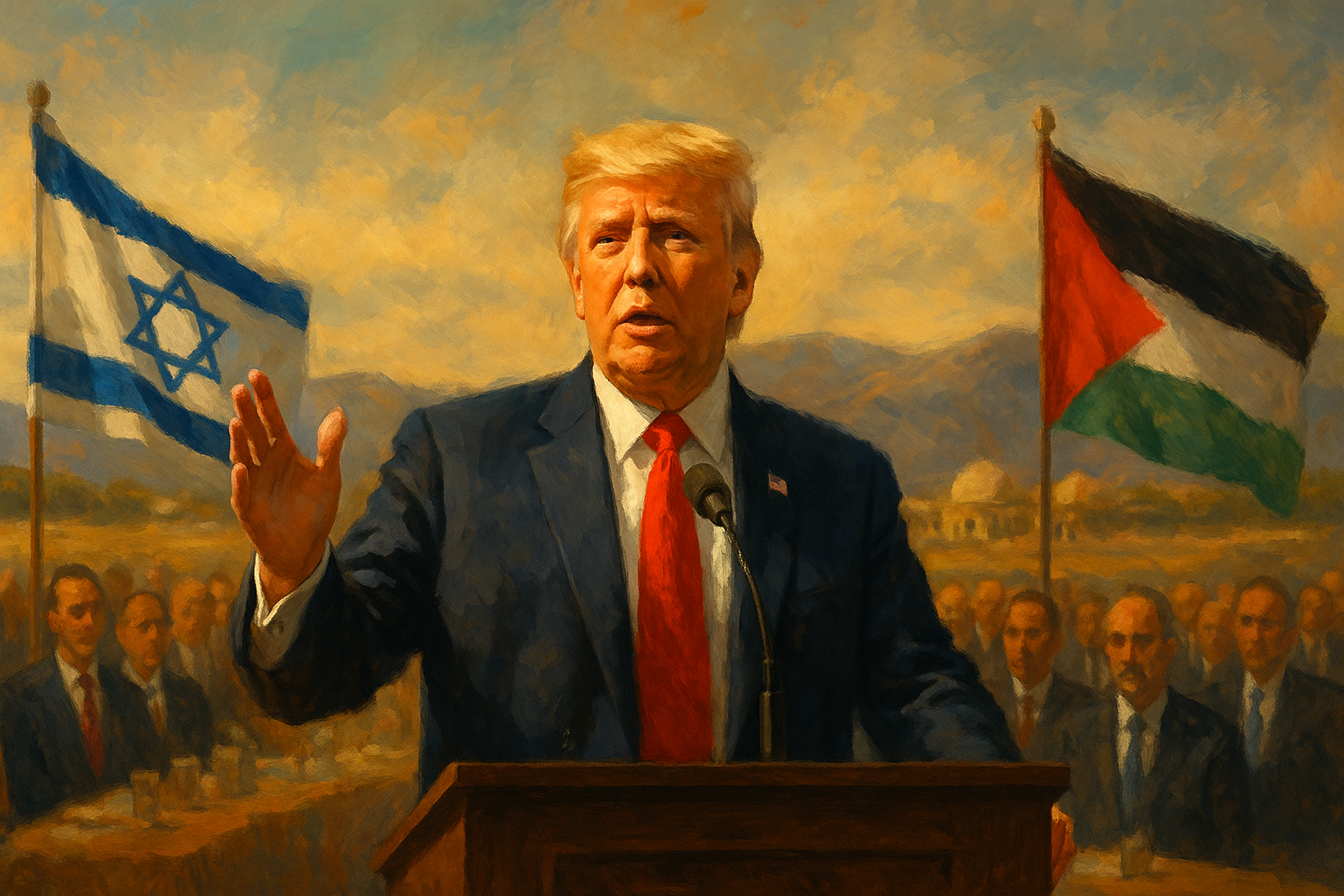
The sudden assault that occurred on October 7, 2025, marked a turning point that shook the Middle East. During the event, Hamas launched a coordinated offensive against southern Israel, firing a number of rockets and conducting ground incursions into several border communities. The attacks caused significant civilian casualties and triggered a major security crisis in the region. Israel responded with a full-scale military operation in the Gaza Strip, resulting in heavy losses on both sides and extensive destruction of infrastructure. The conflict rapidly escalated, provoking international diplomatic pressure and fears of a broader regional war. Within this context, the United States, under the leadership of President Donald Trump, assumed a dominant role in mediating negotiations that ultimately culminated in the Sharm El-Sheikh Peace Summit 2025.
The ceasefire between Israel and Hamas, announced later that October, became one of the most defining moments in recent Middle Eastern politics and U.S. foreign policy. The agreement—formally known as the Sharm El-Sheikh Peace Summit 2025—produced the Gaza Ceasefire Declaration, marking the end of one of the most destructive phases of modern conflict in Gaza. President Trump, having returned to office earlier that year, placed himself at the forefront of a rapid diplomatic drive that led to the cessation of hostilities. His administration introduced the “20-Point Plan for Gaza Peace,” which served as the principal framework of the negotiations. The plan included provisions for halting military operations, exchanging hostages, opening humanitarian corridors, and forming a transitional government under international supervision. Though fragile, the Sharm El-Sheikh agreement signaled a fundamental shift in U.S. foreign policy—from traditional multilateralism to a more direct, pragmatic, and results-oriented diplomacy.
To grasp the historical magnitude of this accord, one must recall the long and painful history of the Israeli-Palestinian conflict. Since 1948, war after war has erupted, leaving behind deep scars and enduring hostilities. Gaza has been the flashpoint since Hamas took control in 2007, characterized by recurring cycles of rocket attacks and Israeli military operations. Earlier diplomatic efforts—from the Oslo Accords (1993) and the Egyptian Initiative (2014) to the Qatari Mediation (2021)—failed to achieve lasting peace. Thus, when Trump successfully brought Israeli and Hamas delegations together in Sharm El-Sheikh, under Egyptian and Qatari mediation, the world regarded it as the most significant American diplomatic breakthrough since Oslo.
Trump’s diplomatic style at the Sharm El-Sheikh Peace Summit underscored a transformation in U.S. foreign policy conduct. Rather than waiting for U.N. consensus or lengthy multilateral procedures, he opted for a personal, transactional, and leverage-based approach—combining economic pressure, direct relationships with regional leaders, and symbolic military deterrence to drive the deal. Analysts often describe this as the “Trump Doctrine”: diplomacy that prioritizes concrete outcomes, disregards bureaucratic conventions, yet effectively creates political momentum.
This success also reflected a broader strategic repositioning of the United States in the Middle East. After years of diminished credibility due to protracted wars, Washington sought to reassert itself as a decisive force for peace. By working closely with Egypt as the main mediator, and with Qatar and the United Arab Emirates as financial and logistical supporters, the U.S. demonstrated its willingness to cooperate with Arab states without abandoning its historic alliance with Israel. The strategy produced a new equilibrium—maintaining old allies while cultivating new legitimacy in the Muslim world.
Nevertheless, the praise directed at Trump has been accompanied by substantial criticism. Many observers argue that the agreement did not arise solely from American initiative. Internal pressures in Israel, public fatigue with the conflict, and demands from the families of hostages played major roles in driving the ceasefire. Moreover, the real challenge lies in implementation: demilitarizing Hamas, establishing a transitional governance structure in Gaza, withdrawing Israeli troops, and reconstructing war-torn areas. These steps require diplomatic consistency and long-term commitment—qualities that American foreign policy has not always sustained.
From a geopolitical standpoint, U.S. involvement in this accord produced a strategic dilemma. On one hand, the Sharm El-Sheikh Peace Summit reinforced America’s image as a global hegemon still relevant in the Middle East. On the other hand, an excessive focus on the region risks diverting Washington’s attention and resources from its larger strategic rivalries with China in the Asia-Pacific and Russia in Eastern Europe. In the best-case scenario, the accord symbolizes a renewal of American hegemony; in the worst, it could become a classic geopolitical trap, draining diplomatic energy without yielding lasting results.
The success of the Sharm El-Sheikh Peace Summit also cannot be separated from U.S. domestic politics. Trump framed the agreement as tangible proof of his campaign promise to “end wars within twenty-four hours.” His rhetoric of strength and decisiveness bolstered his electoral base ahead of the midterm elections. Yet foreign policy built on personality is inherently fragile: one failure in the agreement’s implementation could swiftly dismantle the symbol of triumph he constructed.
In the broader global context, U.S. diplomacy during the Sharm El-Sheikh Peace Summit epitomized a shift from multilateralism to coercive pragmatism. Washington no longer waited for collective consensus but instead acted unilaterally to shape a new diplomatic reality. Such an approach may generate rapid results, but it also carries the risk of eroding legitimacy if not supported by sustained international cooperation and post-war reconstruction.
Ultimately, U.S. foreign policy in the Sharm El-Sheikh Peace Summit 2025 reveals two faces: one of power and diplomatic efficiency, and another of fragility—of a peace system constructed through political pressure and personal leadership. If the U.S. maintains diplomatic consistency and leads Gaza’s reconstruction with enduring commitment, the accord may stand as a new milestone of American hegemony in a multipolar order. But if it fails, the Sharm El-Sheikh Peace Summit will be remembered merely as a temporary victory—a spectacle of success without substance.
The October 7 attack ultimately became a turning point for Donald Trump’s global legitimacy. The crisis that began in Gaza offered him an opportunity to restore the image of the United States as a nation capable of defining the direction of world politics. By seizing this moment, Trump presented America not as a reactive power but as an actor orchestrating the rhythm of global diplomacy. The world watched as Washington transformed tragedy into a stage for reasserting its hegemonic role—that amid global fragmentation and disorder, only the United States still possessed the capacity to compel peace. In this sense, the Sharm El-Sheikh Peace Summit 2025 not only marked the end of a war but also signified the rebirth of American foreign policy as the gravitational center of global power.


